

Our Global export market
We provide our services all over the world. Where we can serve you ?
Contact Us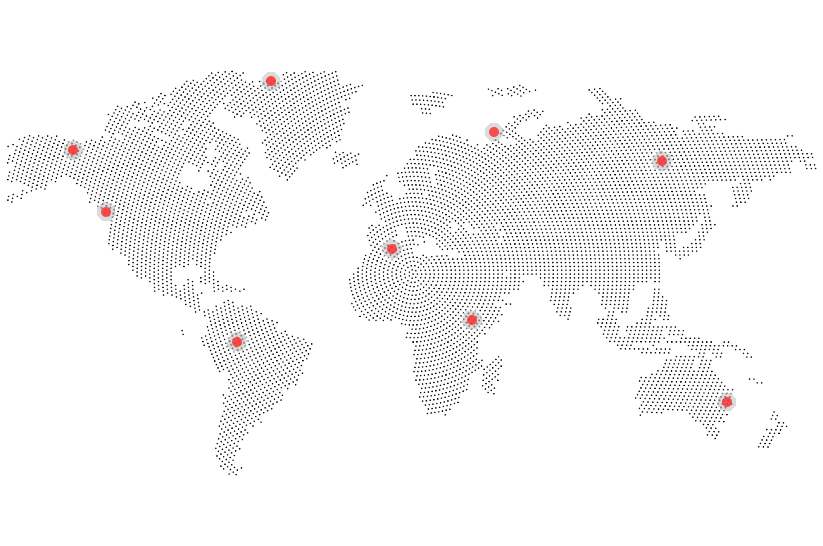
24 June 2026
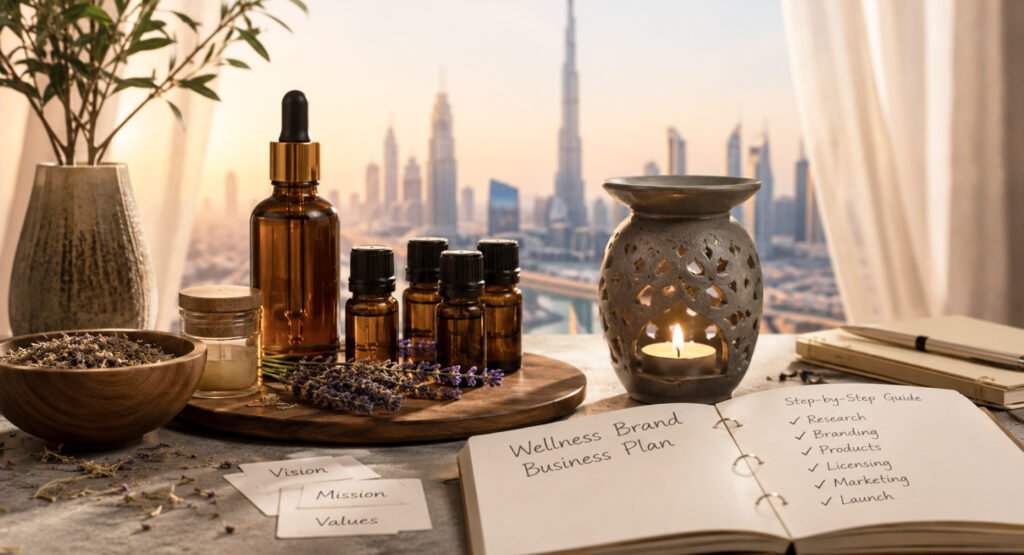
Starting an aromatherapy and wellness brand in Dubai is more achievable than most people think. You need a trade license, product registration through Dubai Municipality’s Montaji portal, a reliable essential oil and diffuser supplier, and a positioning strategy that speaks to Dubai’s affluent, health-conscious market. Do those four things right, and you’re entering one of the fastest-growing wellness markets on the planet.
Dubai’s aromatherapy sector sits within a UAE aromatherapy market forecast at USD 19.94 million in 2025, inside a Middle East sector valued at approximately USD 330 million (Meydan FZ, 2026). Globally, the aromatherapy industry hit USD 9.2 billion in 2024 and is on track to reach USD 20.1 billion by 2034. Those aren’t speculative numbers. They reflect a genuine, structural shift in how people spend money on health, home, and hospitality. And Dubai sits right at the centre of it.
This guide walks you through every stage of launching your aromatherapy and wellness brand in Dubai, from choosing your business structure to sourcing GC-MS tested essential oils and ceramic diffusers, registering products with Dubai Municipality, building your brand identity, and marketing to spas, retailers, and consumers. Whether you’re a first-time founder or an established business expanding into this category, you’ll find a clear, practical roadmap here.
Dubai is the right market because of the rare combination of affluent consumers, a regulated but business-friendly environment, a booming hospitality sector hungry for wellness products, and direct access to GCC distribution networks.
A few numbers make this concrete. The UAE spa market was valued at around USD 1.4 billion in 2024 and is forecast to expand at a CAGR of 8.5% through 2034 (KWS Middle East, 2025). UAE wellness tourism revenue grew by 18% in 2025 alone. Dubai revealed the USD 545 million Therme Dubai resort, a facility built specifically around holistic and therapeutic experiences. The UAE and Saudi Arabia collectively operated over 650 wellness resorts and spa clinics in 2023, with 75% of those establishments including aromatherapy in their treatment menus.
That’s your B2B market right there: spas, hotels, yoga studios, and corporate wellness programs, all actively sourcing essential oils, aromatherapy diffusers, and blended products. Add the retail consumer, who is increasingly buying diffusers and essential oils for home use, and you have two strong revenue channels from day one.
Dubai also makes sense logistically. It’s an ideal export hub with access to Saudi Arabia, Oman, Qatar, Bahrain, Kuwait, and beyond. A UAE-based company lets you invoice in AED, hold a UAE trade license, and contract directly with regional buyers, which is something overseas suppliers genuinely can’t do.
Your business model choice shapes everything: your license type, your product range, your sourcing strategy, and your margins. There are four main models worth knowing.
1. Private Label Brand You source finished essential oils, blends, diffusers, and body care products from a wholesale manufacturer, apply your own branding, register the products under your company, and sell them. This is the fastest route to market and often the most capital-efficient. Profit margins for essential oil products typically range from 50% to 200%, making private labelling financially attractive.
2. Contract Manufacturing / Custom Formulation You work with a manufacturer to create proprietary blends and formulations exclusive to your brand. This gives you differentiation but requires more lead time, higher minimum order quantities, and deeper product development investment.
3. Retail Distribution / Wholesale You import established aromatherapy brands and distribute them to spas, hotels, pharmacies, and retail stores across the UAE and GCC. This model is heavily relationship-driven but scales quickly once you build the right client base.
4. Direct-to-Consumer (DTC) E-Commerce You build an online store targeting UAE and regional consumers, combining essential oils, diffusers, gift sets, and wellness accessories. DTC offers the highest margin per unit but demands strong digital marketing investment.
Most successful aromatherapy and wellness brands in Dubai start with a private label model combined with a B2B hospitality channel, then layer in DTC once the brand has traction.
Registering a company for an aromatherapy and wellness business in Dubai involves three key decisions: your legal structure, your jurisdiction (mainland vs free zone), and your trade license activity.
| Factor | Mainland (DED) | Free Zone (e.g., DMCC, DHCC) |
|---|---|---|
| UAE market access | Unrestricted | Limited; may need a distributor for direct retail |
| Foreign ownership | 100% allowed (post-2021 reforms) | 100% allowed |
| Physical retail | Yes | Usually no (office-only zones) |
| Tax benefits | Standard UAE corporate tax | Often 0% corporate tax within zone |
| Setup cost | AED 15,000 to 25,000+ | AED 10,000 to 20,000+ |
| Best for | Spas, retail stores, B2B distribution | E-commerce, consulting, export-focused brands |
For most aromatherapy brands wanting to supply UAE spas, hotels, and retailers directly, a mainland DED license is the cleaner choice. If your primary model is online or GCC export, a free zone like DMCC works well.
The entire process typically takes two to four weeks with proper documentation.
This is where most new founders hit delays. Knowing which authorities govern your products upfront saves weeks.
Dubai Municipality (DM) via the Montaji Portal All cosmetics, fragrances, personal care products, and essential oils sold in Dubai must be registered through the Montaji portal. This is your primary compliance step for product approvals. As the Artixio compliance guide notes, registration costs AED 10 per application, plus AED 200 per registration certificate, and approvals take up to 22 working days from a completed application.
MoIAT (Ministry of Industry & Advanced Technology, formerly ESMA) For products requiring ECAS (Emirates Conformity Assessment Scheme) certification, you’ll need a Certificate of Conformity issued by an accredited body like Intertek. The ECAS certificate is proof of approval by the UAE Federal Government and is mandatory for customs clearance of regulated products. It’s valid for one year and must be renewed annually.
Dubai Health Authority (DHA) Required if you’re offering aromatherapy as a clinical or therapeutic service, or if your wellness brand includes health claims on product labels.
Pro tip from working with multiple wellness founders: get your labels reviewed before you print them. Non-compliant claims (for example, saying an oil “treats anxiety” rather than “promotes relaxation”) are the most common reason for product rejection.
Building the right product range is a balance between market demand, sourcing capability, and regulatory simplicity. Start focused, then expand.
A practical launch range for a Dubai aromatherapy brand typically looks like this:
GC-MS (Gas Chromatography-Mass Spectrometry) testing is the industry standard for verifying essential oil purity and composition. When I’ve audited product lines for wellness brands entering the UAE, sourcing GC-MS tested, certified-pure oils was consistently the factor separating brands that passed Montaji review quickly from those that didn’t. Buyers in Dubai’s spa and hospitality sector now routinely ask for GC-MS reports before placing bulk orders.
Sourcing from an ISO 9001 certified, government-recognized manufacturer ensures you get documentation that holds up under regulatory scrutiny. Ashwani LLC’s pure and organic essential oils come with the quality certifications that Dubai’s market demands.
Sourcing is where your brand’s quality, cost structure, and competitive positioning get decided. There are three main approaches.
This is the most practical route for most new brands. You work with an established manufacturer who supplies finished products (oils, diffusers, bath care) that you rebrand and sell. The key is finding a supplier with:
Ashwani LLC’s private labelling service is purpose-built for exactly this. With over 25 years of manufacturing experience, 600+ formulations, and reach across 195 countries, it gives new brands a production foundation that would take years and significant capital to build independently.
Sourcing lavender from France, frankincense from Oman, or sandalwood from India directly can give you quality differentiation and story-driven marketing angles. The trade-off is complexity: you need importers, customs clearance, ECAS certification per shipment, and larger MOQs.
For speed and logistics simplicity, sourcing from a wholesale supplier in the UAE reduces lead times, simplifies documentation, and keeps your supply chain inside a single regulatory jurisdiction. This matters when you’re scaling and need reliable restocking cycles.
If you want to position your aromatherapy brand in Dubai’s luxury segment, ceramic diffusers are your visual anchor. They’re gifts, they’re decor, and they’re functional wellness products. Handmade ceramic diffusers crafted with precision using premium raw materials are increasingly the product that gets Instagram attention and justifies premium retail pricing. Check Ashwani LLC’s ceramic diffuser catalogue for a sense of what’s available at wholesale for private label branding.
Packaging is not a cosmetic decision for a Dubai wellness brand. It’s a regulatory requirement and a commercial lever simultaneously.
All products sold in Dubai must carry bilingual labels (English and Arabic). Required label information includes:
Missing any of these from your label triggers rejection on the Montaji portal and delays your entire product launch.
Beyond compliance, your packaging communicates your brand positioning. In Dubai’s wellness market, consumers respond to clean, minimal aesthetics, natural material cues (kraft paper, glass, ceramic), and Arabic calligraphy as a design element. Gifting is a massive purchase driver in the UAE, so packaging that photographs well and feels premium in hand directly affects conversion.
Ashwani LLC’s packaging solutions cover tubes, glass dropper bottles, glass jars, and custom labelling, which means you can handle both the regulatory and the brand aesthetic requirements from one supplier.
Dubai’s wellness market is segmented, and the brands that win pick a lane rather than trying to serve everyone.
Luxury Wellness: Premium pricing, beautiful packaging, positioned for five-star hotel amenity programmes, luxury spa chains, and gifting. Think frankincense-based collections with Arabic heritage storytelling.
Everyday Wellness: Accessible price points, practical benefits (sleep, stress, focus), DTC-friendly formats, strong social media presence. Targets Dubai’s expat professionals aged 25 to 45.
Clinical/Holistic Wellness: Targeted at practitioners, yoga studios, meditation centres, and corporate wellness programmes. Emphasises therapeutic-grade certifications, practitioner education, and B2B supply relationships.
Most brands begin with one positioning and adjacent channel. Straddling all three early on dilutes your messaging and complicates your supply chain.
Instagram and TikTok are non-negotiable for consumer wellness brands in Dubai. Short-form video showing diffuser aesthetics, blending rituals, and ingredient sourcing stories performs exceptionally well with UAE’s young, visual, wellness-curious audience.
B2B Direct Outreach: The hospitality sector here is relationship-driven. A concierge call, a sample pack, and a meeting with a spa procurement manager will move faster than any paid ad. Over 70% of UAE consumers trust recommendations from health professionals when buying natural wellness products (KWS Middle East, 2025). That trust extends to spa therapists and wellness consultants.
Google Business and SEO: Search intent for “essential oils Dubai,” “aromatherapy diffuser Dubai,” and “wellness gift sets UAE” is high and growing. A well-structured website with product pages, educational content, and blog posts around aromatherapy use cases will compound over time.
Marketplaces: Noon.com and Amazon.ae are viable DTC channels for essential oils and diffusers, especially for reaching price-sensitive consumers outside the luxury segment.
Pop-ups and wellness events: Dubai runs regular wellness expos, farmers’ markets (Ripe Market, Dubai Hills Market), and corporate wellness days. These are brand-building and sampling events, not necessarily high-revenue days, but the brand exposure and retailer connections are valuable early on.
Scaling from Dubai into the broader GCC is a natural second chapter for any wellness brand that establishes UAE distribution first.
Here’s what scaling looks like in practice:
A UAE-registered company with a mainland DED license is structured to contract across the GCC from day one. That’s a real competitive advantage over brands operating from outside the region.
Starting an aromatherapy and wellness brand in Dubai is a genuine business opportunity right now. The market data, the infrastructure, and the consumer appetite are all aligned. But the brands that succeed aren’t the ones with the best oils or the prettiest packaging in isolation. They’re the ones who combine those things with proper legal structure, fully compliant product registration, a reliable supply chain, and a positioning story that resonates with Dubai’s market.
Let me give you a quick summary of the journey:
The next step is practical, not conceptual. If you’re ready to discuss product sourcing, private labelling, or packaging for your wellness brand, contact the Ashwani LLC team directly. With 25 years of manufacturing experience, ISO 9001 certification, and a product range spanning pure essential oils, ceramic diffusers, and bath and body care, Ashwani LLC has been the backbone behind wellness brands building in Dubai and across the globe. Explore the full product catalogue and see what’s possible for your brand.
An aromatherapy and wellness brand in Dubai is a business that markets and sells products such as essential oils, diffusers, blended formulations, and related bath or body care under its own brand identity. These businesses are registered under UAE trade license frameworks and must comply with Dubai Municipality product registration requirements. The Dubai aromatherapy market is growing rapidly, valued as part of a USD 330 million Middle East sector.
Starting a wellness brand in Dubai typically requires AED 15,000 to 25,000 for a mainland trade license, plus AED 10,000 to 20,000 for initial product registration and labelling compliance. Initial inventory investment commonly starts around AED 20,000 to 50,000 depending on your product range and MOQs. A lean private label brand can launch for under AED 100,000 total, including licensing, product, packaging, and basic marketing.
Yes. All essential oils, aromatherapy blends, and cosmetic or personal care products sold in Dubai must be registered with Dubai Municipality through the Montaji portal before they can be legally imported or sold. Registration requires GC-MS test documentation, a Safety Data Sheet, compliant bilingual labels, and your UAE trade license. The process takes up to 22 working days from a completed application.
Montaji is Dubai Municipality’s electronic system for registering cosmetics, fragrances, personal care products, and consumer goods. Any company wanting to sell regulated products in Dubai must first register the company on Montaji, then submit each product for label assessment and compliance review. Products cannot be legally imported or sold in Dubai without Montaji approval. Registration fees are AED 10 per application plus AED 200 per certificate.
For most aromatherapy brands targeting UAE spas, retailers, and direct consumers, a mainland DED license is the better choice because it allows unrestricted trading anywhere in the UAE. Free zone licenses suit brands focused primarily on e-commerce, export, or consulting models. If you want to supply Dubai hotels, sell through UAE retailers, or run pop-up events, mainland licensing removes the distribution limitations.
Frankincense, oud-based blends, rose, lavender, and eucalyptus are consistently the strongest sellers in Dubai and the GCC. Frankincense has deep cultural resonance in the Gulf region. Lavender and eucalyptus dominate the spa and hotel amenity segment. Oud-infused wellness products bridge the aromatherapy category with the region’s strong fragrance tradition and command premium pricing.
Look for a manufacturer that holds ISO 9001 certification, provides GC-MS tested oil documentation, supports custom formulations, and has experience supplying the UAE and GCC markets. Ashwani LLC is a government-recognised, ISO 9001 certified wholesale manufacturer and private label supplier based in Business Bay, Dubai, with over 25 years of manufacturing experience and a product range covering pure essential oils, ceramic diffusers, and bath and body care.
ECAS (Emirates Conformity Assessment Scheme) certification is issued by MoIAT (formerly ESMA) and confirms that products meet UAE federal standards. All cosmetics, perfumery, and personal care products placed in the UAE market must have ECAS Certificates of Conformity (CoC) issued by an accredited body. The CoC is mandatory for customs clearance and placing products in the UAE market. It’s valid for one year and requires annual renewal.
Diffusers are both a standalone revenue category and a powerful brand positioning tool. Ceramic diffusers in particular resonate in Dubai’s luxury wellness and gifting market. They extend your brand’s visual presence in homes, spas, and hotels. Diffusers also create repeat purchase behaviour because they drive ongoing essential oil sales. Offering a signature ceramic diffuser alongside your oil range is one of the most effective ways to increase average customer lifetime value.
Yes. Since the UAE’s 2021 Commercial Companies Law reforms, foreign nationals can own 100% of a mainland UAE company in most business activities, including trading in cosmetics, essential oils, and wellness products. Free zones have always permitted 100% foreign ownership. This change removed a significant barrier and makes Dubai straightforwardly accessible for international wellness entrepreneurs wanting to build and own their brand entirely.
