

Our Global export market
We provide our services all over the world. Where we can serve you ?
Contact Us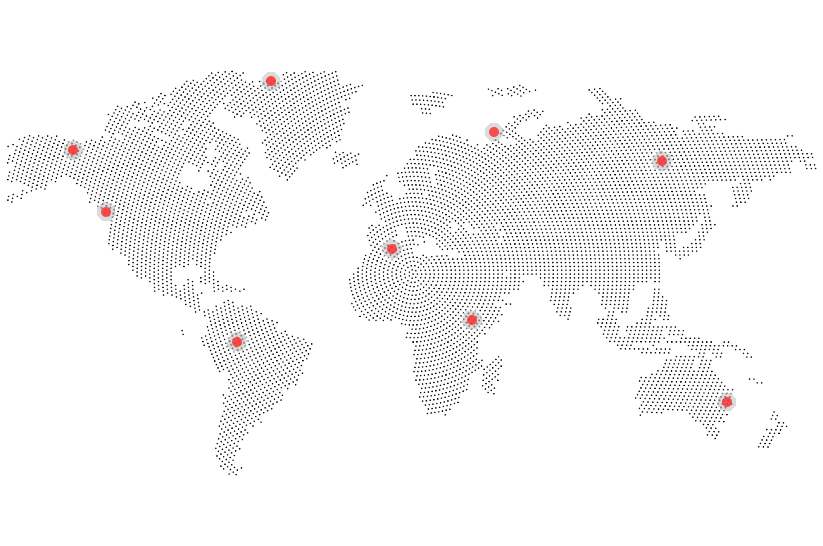
12 January 2026
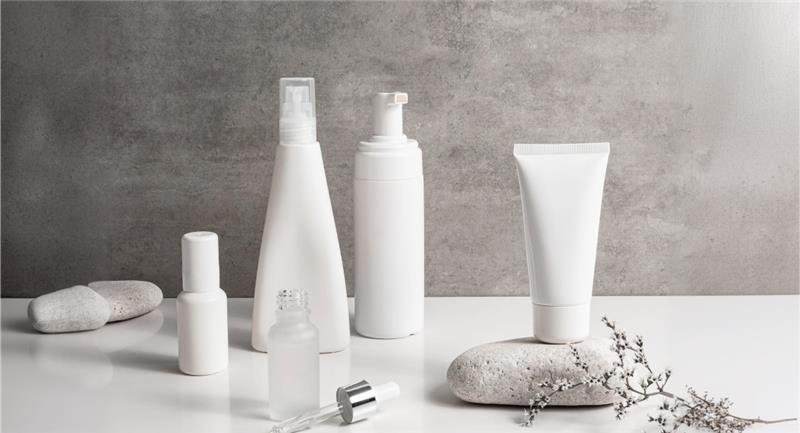
Speed is the quiet killer of many promising product brands in the UAE. Not because founders lack ideas, funding, or ambition but because they underestimate how long it truly takes to build manufacturing capability from scratch in a regulated, quality-sensitive market like the UAE. By the time an in-house setup is operational, the market has often moved, competitors have launched, and early momentum is lost. This article solves one core problem: how to launch products faster, with less operational risk, while staying compliant and brand-driven in the UAE. It explains why, for many categories, working with private label manufacturers in UAE is a smarter strategic decision than building everything internally, especially in the early and growth stages.
What you’ll gain here is not theory, but decision clarity: when private labeling makes sense, what trade-offs exist, and how to evaluate manufacturers without compromising long-term brand value.
Most founders assume manufacturing is a linear challenge: find space, buy machines, hire staff, start producing. In the UAE, it rarely works that way.
Building your own facility introduces multiple parallel delays:
Each step is manageable—but together, they extend timelines from months to one to two years before meaningful production begins.
Private label manufacturing exists to remove these friction points.
Private label manufacturing is often misunderstood as “white-labeling with a logo.” In practice, reputable manufacturers in the UAE operate far beyond that.
A strong private label partner typically provides:
This model is especially mature in sectors like cosmetics, personal care, food supplements, and wellness—making Private Labeling For Cosmetics in Dubai one of the fastest-growing segments.
Speed is not just about launching earlier. It directly impacts cost, feedback, and brand learning.
By leveraging existing infrastructure, brands can:
In contrast, in-house manufacturing locks you into early decisions that are difficult to reverse.
Instead of asking “Which is cheaper?”, experienced founders ask better questions.
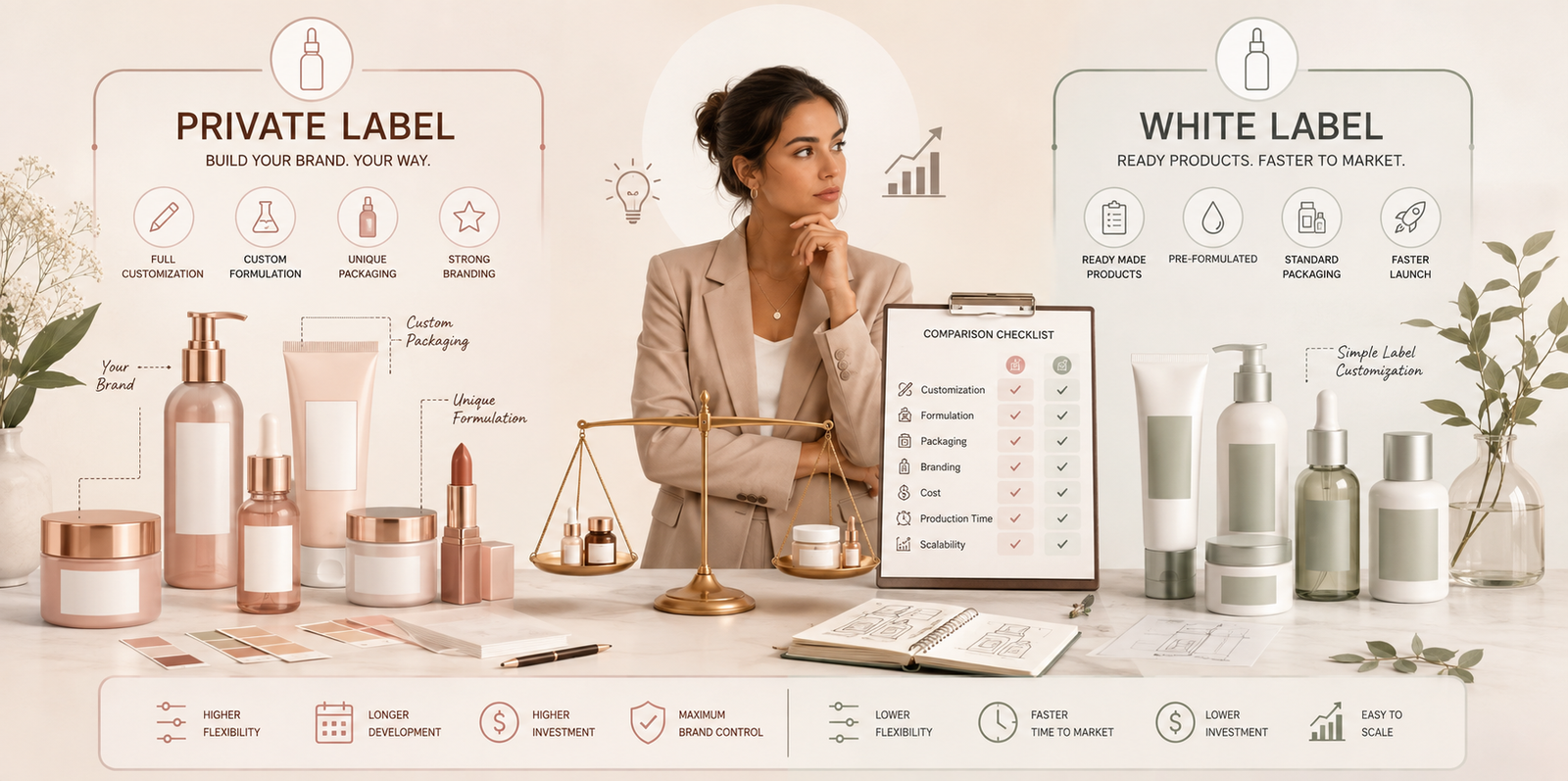
Use this checklist before committing:
Private Label is usually better if:
In-House makes sense when:
Most early-stage and scaling brands fall squarely into the first category.
On paper, owning manufacturing looks cheaper per unit. In reality, hidden costs accumulate quickly.
Private label manufacturing converts many of these fixed costs into variable ones—protecting cash flow during uncertain growth phases.
A common fear is loss of quality control. In the UAE, this concern is often outdated.
Experienced private label manufacturers already operate under:
For categories like cosmetics, working with licensed facilities in Dubai significantly reduces compliance risk compared to first-time setups.
One of the most under-discussed benefits of private labeling is operational learning without operational risk.
By working closely with manufacturers, founders gain:
Many successful brands like Ashwani LLC later move partial production in-house not because private labeling failed, but because it helped them build informed manufacturing strategy.
Speed should never replace due diligence.
Choosing the wrong partner can slow you down as much as building in-house.
In the UAE’s fast-moving consumer and beauty markets, speed is not a shortcut – it is a strategy. Private label manufacturing allows founders to focus on what truly builds brands: understanding customers, refining positioning, and scaling distribution. In-house manufacturing can come later, informed by real demand rather than assumptions. The smartest launches are rarely the most complex ones. They are the ones that remove friction early and compound learning fast.
Yes, if executed correctly. Premium positioning depends on formulation quality, branding, and customer experience—not ownership of machinery. Many high-end brands globally rely on private manufacturing partners while maintaining strict quality oversight.
Depending on category and customization, launches can happen within 6 to 12 weeks. This includes formulation alignment, packaging approval, and compliance checks, assuming decisions are made promptly.
Reputable manufacturers allow controlled customization of formulations, fragrances, textures, and packaging. Full customization may require higher MOQs, but partial differentiation is often sufficient for market entry.
Initially, per-unit costs may be higher. However, when factoring in capital expenditure, staffing, compliance, and risk, private labeling is often more cost-efficient until volumes reach a stable scale.
Control depends on contract structure. Clear agreements around formulation ownership, exclusivity, and quality standards ensure founders retain strategic control while outsourcing execution.
