


Our Global export market
We provide our services all over the world. Where we can serve you ?
Contact Us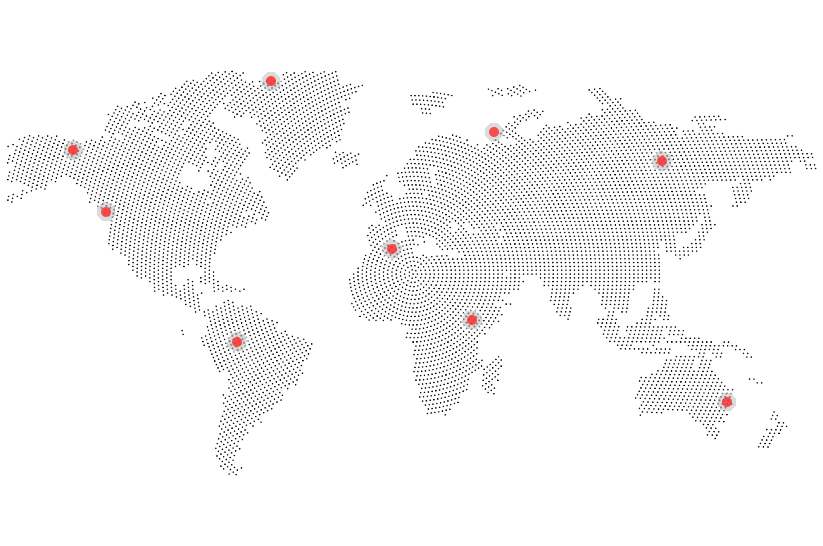
28 May 2026
Most wellness brand founders spend weeks comparing price sheets from mass manufacturers in China or India, chasing the lowest per-unit cost. Then, six months into their launch, they find themselves dealing with a frustrating reality: their products look like everyone else’s, their return rates are creeping up, and their customers are posting lukewarm reviews about “cheap plastic smell” or cracking ceramic.
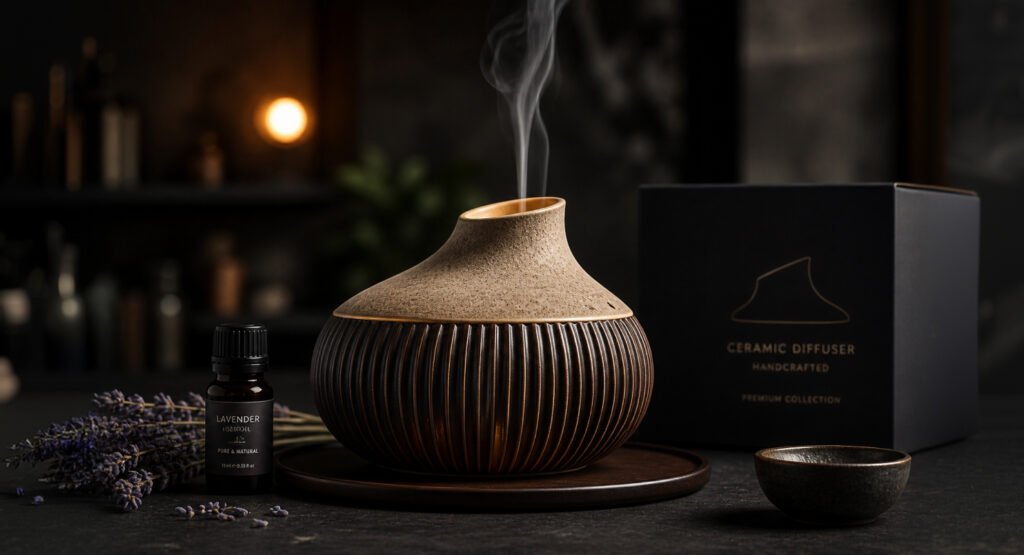
The brands that avoid this trap share a common thread. They shifted their sourcing logic early, from price-first to product-first, and many of them landed on a supplier category that is still under the radar for most new entrants: ceramic diffuser wholesale manufacturers based in the UAE.
This blog breaks down why that decision makes sense, what to look for in a ceramic diffuser supplier in Dubai, how handmade production actually impacts your brand equity, and the practical questions you need answered before you sign any purchase order.
Before talking about sourcing, it is worth understanding the product category itself, because the growth here is not a trend. It is a structural shift in how consumers relate to aromatherapy.
Ceramic diffusers, particularly passive or heat-based styles, appeal to a segment of buyers who are growing skeptical of electronic ultrasonic units. The concerns are real: electromagnetic sensitivity, noise during sleep, mineral deposits on internal components, and the psychological friction of maintaining a small appliance. Ceramic passive diffusers eliminate most of these objections entirely.
From a retail standpoint, ceramic diffusers also carry stronger visual merchandising weight. They photograph well, they read as premium and artisan, and they pair naturally with wellness product bundles, candles, essential oils, and linen sprays. Brands that understand visual commerce are finding ceramic pieces drive higher average order values because customers instinctively perceive more value.
From a wellness brand positioning perspective, the material itself carries meaning. Ceramic has deep cultural roots in ritual and domestic life across the Middle East, South Asia, and East Asia. That authenticity is difficult to manufacture in polypropylene.
One of the most misunderstood aspects of sourcing handmade ceramics at scale is what “handmade” actually means when you are ordering 500, 2,000, or 10,000 units.
There is a spectrum, and knowing where your supplier sits on it matters.
Fully hand-thrown pieces are formed individually on a pottery wheel by a skilled artisan. Each piece will carry natural variation in wall thickness, glaze distribution, and even slightly different dimensions. This is not a defect. It is a characteristic. Brands selling to premium or artisan-positioned markets often highlight this variation as proof of authenticity.
Hand-finished with mold-formed bodies is the middle ground that most serious wholesale ceramic manufacturers use. The basic form is created using a semi-automated mold process to ensure structural consistency and dimension accuracy, then the finishing, glazing, and quality inspection are done by hand. This approach makes wholesale feasible without sacrificing the handmade aesthetic.
Slip-cast with hand-applied glaze offers the most consistency for larger orders while still preserving visual warmth. The glaze application by hand ensures no two pieces are identical, which remains a marketable feature.
When evaluating a ceramic diffuser wholesale manufacturer, ask directly where they sit on this spectrum and what their tolerance ranges look like for dimensional variation. A manufacturer that cannot answer this clearly is likely reselling rather than producing.
The emergence of Dubai and the broader UAE as a sourcing destination for wellness products is not accidental. Several structural factors have made the region competitive in ways that are not obvious from the outside.
Geographic advantage for global distribution. Dubai sits at the intersection of Europe, Asia, and Africa. For brands selling across multiple markets, the logistics math is genuinely different compared to shipping from East Asia. Transit times to the UK, Germany, South Africa, and India are all competitive. This is not a marketing claim. It reflects actual freight lane efficiency through Jebel Ali Port and Dubai International Airport, both consistently ranked among the world’s busiest.
Material quality standards shaped by regional demand. The Gulf wellness and luxury home market is demanding. Consumers in the UAE, Saudi Arabia, and Qatar have high expectations for handcraft quality, and the manufacturers serving this regional market have developed production standards that reflect that. When you source from a ceramic diffuser supplier in Dubai, you are often benefiting from quality controls developed for one of the world’s most discerning consumer bases.
Regulatory environment and compliance documentation. The UAE has a clear regulatory framework for manufacturing and export. Compliance documentation, certificates of origin, and safety testing records are easier to obtain compared to some other manufacturing regions. For brands selling into the EU or UK market, this matters more than most new founders realize when they are placing their first order.
Design sensibility rooted in cultural craft tradition. The Gulf region has centuries of artistic tradition in ceramic and clay work, mosaic, and decorative arts. This heritage informs the design language of manufacturers operating here in ways that are directly commercial. The aesthetic output, geometric patterns, botanical motifs, matte earth tones, tends to align naturally with what the global wellness retail market currently wants.
This distinction is critical and often obscured in supplier directories.
A genuine manufacturer controls the production process. They own or operate the kilns, they employ the artisans, they make decisions about glaze chemistry and firing schedules, and they have the ability to modify a product based on your specification. When you want a bespoke shape, a private label finish, or a change to the diffuser reed hole configuration, a real manufacturer can quote and deliver that. Lead times are predictable because they are not dependent on a third party.
A middleman sources from manufacturers and resells, often adding a margin while reducing your ability to customize, verify quality directly, or build a direct production relationship. There is nothing inherently wrong with middlemen for buyers who need very small quantities and cannot meet MOQ thresholds. But if you are building a brand and expect to grow, the lack of direct manufacturer access becomes a meaningful constraint.
To distinguish between the two during due diligence:
Ask for a factory visit or a live video walkthrough of the production space. A real manufacturer will accommodate this. A reseller will delay, redirect, or offer photos only.
Ask about their kiln capacity and firing schedule. Real manufacturers will discuss this in practical terms. Resellers either don’t know or give vague answers.
Ask what your customization options are and what they cost. Manufacturers will explain this clearly in terms of tooling costs and minimum run quantities. Resellers will often say customization is “possible” without giving specifics.
Request a sample from your actual specification, not a catalog sample. The turnaround time and willingness to do this is itself a signal.
Whether you are sourcing from Dubai or anywhere else, use this decision framework before committing to any wholesale relationship.
1. Production Transparency Can you verify that production is in-house? Can you visit or view the facility? Is there documentation of the production process, from raw clay sourcing to finished product inspection?
2. Customization Depth Can the supplier modify shape, glaze, size, and reed hole configuration? What are the tooling costs for new molds? What is the minimum order quantity for custom work versus standard catalog pieces?
3. Quality Consistency Documentation Does the supplier have a defined quality control process? What is the acceptable defect rate? How do they handle damaged units on delivery?
4. Logistics and Compliance Capability Can they export directly to your destination market? Do they provide required documentation for customs clearance? Do they have experience exporting to your specific country?
5. Communication and Relationship Quality Are they responsive, clear, and honest about limitations? Do they ask questions about your product goals or just push you to close an order? The quality of the conversation before you order is a reliable predictor of what happens when things get complicated.
Scoring suppliers honestly across these five dimensions eliminates most of the bad options before you spend money on samples or deposits.
This section is rarely discussed in sourcing guides, but it has significant business impact.
When you source handmade ceramic diffusers from an artisan manufacturer, you are acquiring something beyond a product. You are acquiring a narrative. And in wellness retail, narrative converts.
Consumers buying premium wellness products are not just purchasing function. They are purchasing identity, care, and intention. “This diffuser is handmade by artisans in Dubai” carries meaning that “manufactured to ISO standards in a facility” does not, even if both are true simultaneously.
This is not manipulation. It is honest positioning. Handmade production does involve human skill, tradition, and craft. Communicating that accurately to your customer is legitimate marketing, and it differentiates your product in a category that is increasingly saturated with identical ultrasonic white-plastic units.
Brands that connect the sourcing story to the product listing, the packaging, and the email onboarding sequence tend to see measurably higher retention and repeat purchase rates. The diffuser becomes part of a curated world rather than a commodity.
Prioritizing MOQ over quality consistency. A supplier with a low MOQ of 50 units sounds appealing for a brand that has not launched yet. But if their defect rate is 8 percent and their glaze consistency is poor, you are going to spend your margin on customer service and replacement shipping. A slightly higher MOQ from a reliable manufacturer is almost always the better choice.
Not requesting safety testing for essential oil contact. Ceramic diffusers that use reeds or direct absorption will be in contact with undiluted essential oils. The glaze chemistry matters. Lead-free and food-safe glazes are not automatically universal. Ask for testing documentation relevant to your market’s regulatory standards.
Ignoring packaging in the supplier conversation. Ceramic is fragile in transit. How a supplier packages their products for international shipping directly affects your landed defect rate. Ask about inner packaging materials and drop test results. This conversation will also tell you a lot about how experienced they are in export.
Skipping a reference check. Ask any supplier for two or three brands they currently supply. Then actually contact those brands and ask about their experience. This takes thirty minutes and can save you months of frustration.
Treating the first order as a long-term commitment. Your first order with a new manufacturer is a paid pilot. You are validating quality, consistency, communication, and logistics. Treat it as a test and structure it accordingly, not as a full inventory buy.
Choosing a ceramic diffuser wholesale manufacturer is not a procurement exercise. It is a brand decision with downstream effects on product quality, customer perception, margin, storytelling, and long-term loyalty.
Dubai has emerged as a genuinely competitive sourcing location for handmade ceramic diffusers, not because of marketing, but because of real structural advantages in logistics, design culture, quality standards, and regional market sophistication. The best manufacturers here are producing work that meets demanding regional expectations and are increasingly equipped to serve global wellness brands.
The brands that will win in wellness retail are the ones that treat sourcing as part of their brand architecture, not as a cost line to minimize. That means doing the due diligence, asking the right questions, running proper pilot orders, and building real supplier relationships.
If you are evaluating your sourcing options, use the five-dimension framework in this article as your starting structure. Then do the work of actually verifying what you hear. The market rewards brands that get this right, and it is less forgiving than it used to be for those who cut corners on the fundamentals.
MOQ varies significantly by manufacturer and product type. Catalog standard designs from established manufacturers in Dubai typically start at 100 to 200 units per SKU. Custom mold orders, where a new shape is created to your specification, usually carry higher minimums in the 300 to 500 unit range to justify tooling investment. Some suppliers offer mixed-SKU MOQs, meaning you can spread your minimum across multiple designs, which is useful for brands that want product variety without overcommitting to a single style.
The most reliable methods are a direct facility visit or a live video tour of the production space, including the kiln area and glazing workshop. You can also request production documentation, such as clay sourcing records and firing schedules. Ask detailed questions about glaze chemistry and customization lead times. A genuine manufacturer will answer these with specificity. A reseller will give general or evasive responses, because they don’t control the production process themselves.
Reputable manufacturers use lead-free, non-toxic glazes that are tested for contact with organic compounds including essential oils. However, you should not assume this without verification. Request safety testing documentation relevant to your destination market, particularly if you are selling into the EU (where REACH compliance applies) or the US. Ask specifically about glaze composition and whether the products have been tested for essential oil compatibility.
Yes, most established ceramic manufacturers offer both. Custom shapes require mold creation, which involves a one-time tooling cost and typically takes four to six weeks before production sampling can begin. Private label options usually include custom glaze colors, custom packaging, and branded packaging inserts. Some manufacturers also offer surface printing or engraving for logo application. Discuss your requirements before placing any deposit, and get the customization scope confirmed in writing.
Dubai’s logistics infrastructure is among the most developed globally. Jebel Ali Port and Dubai International Airport offer direct freight connections to most major markets. For brands serving Europe, the Middle East, Africa, and South Asia simultaneously, Dubai-based sourcing can reduce transit times and shipping costs compared to East Asian alternatives. The UAE also has free trade agreements with several countries that can affect import duty calculations, so it is worth consulting a freight forwarder familiar with UAE exports for your specific destination market.
Handmade ceramics inherently carry some natural variation. A well-run manufacturer should maintain a defect rate below three to four percent for structural and functional defects, meaning cracks, chips, or reed hole blockages. Cosmetic variation in glaze distribution or color saturation is normal and expected in handmade production, and is generally not classified as a defect. Clarify with your supplier what falls under their warranty or replacement policy before ordering.
For standard catalog products with an established manufacturer, production lead times typically range from three to five weeks, with shipping adding one to three weeks depending on destination and freight mode. Custom orders requiring new mold creation will add four to six weeks to the production timeline. Always build buffer time into your planning, especially for seasonal launches or trade show deadlines.
Yes, and it is commercially significant. Manufacturers in Dubai producing for the regional luxury wellness market have developed design competency in geometric patterns, botanical motifs, and matte earth-tone glazes that align closely with global wellness retail trends. The aesthetic output tends to be more distinctive than what large-scale factories optimized for volume produce. For brands competing in premium or specialty wellness retail, this differentiation can directly support higher retail pricing and stronger shelf presence.
A clear product brief should cover: the diffuser style you need (passive reed, heat-based, or decorative), target dimensions and weight range, glaze color preferences and any specific finishes (matte, gloss, reactive), reed hole configuration (number, diameter), packaging requirements, target retail price point (so the manufacturer understands your cost constraints), destination market, and required certifications. The more specific your brief, the more useful and comparable the quotes you receive will be.
Some do, particularly those with experience serving international markets. Product development support can range from helping refine a design brief to providing prototype iterations before production. This is worth asking about specifically during initial conversations. Manufacturers that offer this service tend to be more invested in long-term supplier relationships rather than transactional volume orders, which is generally a positive signal for a brand building a product line over time.
