


Our Global export market
We provide our services all over the world. Where we can serve you ?
Contact Us
22 May 2026
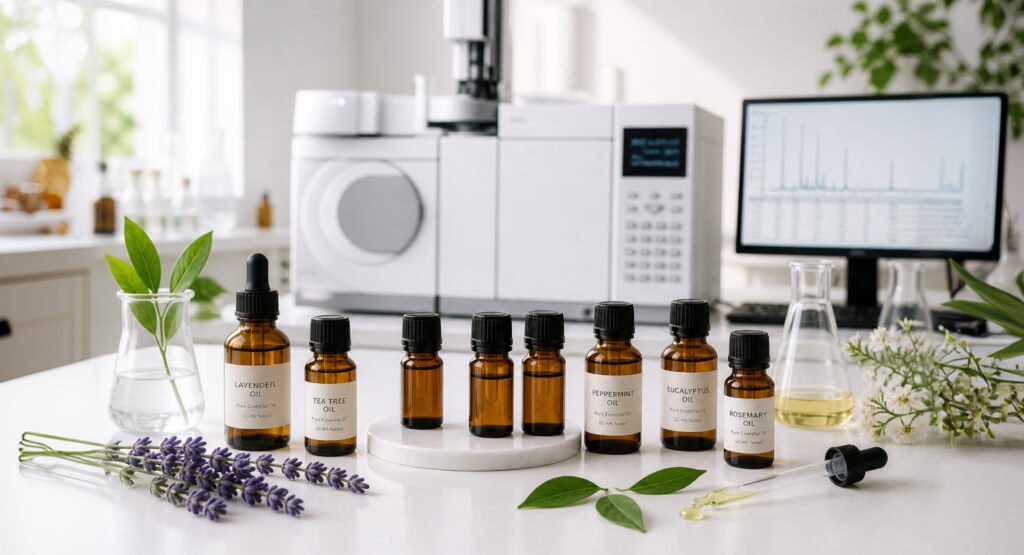
If you’re sourcing essential oils in bulk, GC-MS testing is the single most important quality credential your supplier can provide. GC-MS tested essential oils wholesale means every batch has been analyzed by Gas Chromatography-Mass Spectrometry, a lab process that separates and identifies every chemical compound in the oil down to trace levels. Without it, you’re essentially buying on trust alone – and in the essential oil industry, that’s a risky bet. Here’s the uncomfortable truth: according to a 2015 University of Alabama study published in the journal Natual Product Communications, approximately 80% of commercially available “natural” essential oils are adulterated for economic profit. A more recent 2025 industry analysis from Elchemy found that 75% of commercial lavender oil samples tested positive for adulteration with cheaper alternatives. These aren’t fringe cases. This is the baseline reality of the unverified wholesale market.
For any brand putting its name on a product – whether you’re selling aromatherapy blends, skincare formulations, or wellness products – sourcing non-tested oils creates direct liability. Regulators, retailers, and consumers increasingly demand proof of purity. GC-MS tested essential oils wholesale, particularly from a verified essential oil wholesaler in Dubai, gives you that documented proof.
GC-MS testing is the gold standard analytical method for verifying essential oil purity because it simultaneously separates and identifies every volatile compound present in a sample. Gas Chromatography (GC) vaporizes the oil and passes it through a column, sorting its components by molecular weight and polarity. Mass Spectrometry (MS) then bombards those separated components with electrons, creating a unique “fingerprint” for each one.
The result is a detailed report showing:
Think of it like a blood panel for your oil. Just as a doctor doesn’t just eyeball whether someone is healthy, a reputable supplier doesn’t just smell the oil and call it pure. The GC-MS report is the objective, lab-verified record.
Dr. Robert Pappas, a widely cited essential oil chemist and founder of Essential Oil University, has stated: “GC-MS testing is non-negotiable for any serious professional in this industry. Without it, you cannot make any verifiable claim about purity.” That sentiment is now the industry standard expectation, not a premium service.
Dubai sits at a crossroads that makes it uniquely positioned as a wholesale hub for verified essential oils. Its geographic location connects South Asian growing regions (India, Sri Lanka, Indonesia) with European, African, and American markets through world-class logistics infrastructure.
The UAE’s essential oil market was valued at approximately USD 30.74 billion in 2024 according to Data Bridge Market Research, with Dubai accounting for a substantial share of the region’s wholesale trade. The global essential oils market itself was valued at USD 25.86 billion in 2024 by Grand View Research and is projected to reach USD 28.17 billion in 2025, growing at a CAGR of around 7.35% through 2035 per Precedence Research.
What does this mean for buyers? It means a serious critical mass of manufacturers, testing labs, and logistics infrastructure has consolidated in Dubai. Established suppliers operating in the region are subject to UAE trade and quality regulations, and the most reputable among them comply with ISO standards, export documentation requirements, and in many cases GMP (Good Manufacturing Practice) frameworks.
When working with a reliable essential oil wholesaler in Dubai, buyers gain a few structural advantages that are hard to replicate elsewhere:
This is the content gap I see most often when brands reach out. They know GC-MS testing matters, but when the report lands in their inbox, they don’t know what to do with it. Here’s a practical breakdown.
1. The constituent list and percentages. Each genuine essential oil has an expected chemical fingerprint. Lavender (Lavandula angustifolia), for example, should contain linalool (typically 25-40%) and linalyl acetate (25-45%). If those numbers are significantly off – or if unfamiliar synthetic compounds appear – that’s a red flag.
2. The botanical species declaration. The report should name the exact Latin species. “Lavender oil” is not the same as Lavandula angustifolia, Lavandula latifolia, or hybrid Lavandula x intermedia. Each has a different chemical profile and different therapeutic properties.
3. The testing lab’s accreditation. Look for ISO 17025 accreditation on the laboratory. This confirms the lab meets international competence standards for testing. An in-house report from the same company that sells you the oil is a lower confidence credential than an independent third-party report.
4. The batch number and date. GC-MS reports should correspond to a specific batch, not a general product. If a supplier sends you a generic report with no batch reference, ask for the batch-specific version. Each production run can vary.
5. Absence of adulterants. The report should be clean of synthetic compounds like diethyl phthalate (DEP, commonly used to dilute fragrances), propylene glycol, or synthetic linalool that doesn’t match the isotope ratios of naturally derived linalool.
| Factor | GC-MS Verified Wholesale Oils | Unverified Wholesale Oils |
|---|---|---|
| Purity confirmation | Lab-documented per batch | Supplier’s word only |
| Adulterant detection | Identified and disclosed | Unknown, undetected |
| Regulatory compliance | Supports EU, FDA, GCC filings | May fail compliance checks |
| Brand liability | Significantly reduced | Higher exposure to product recalls |
| Pricing | Slightly higher per kg | Lower upfront cost |
| Long-term reliability | Consistent batch-to-batch | Variable, unreliable |
| Customer trust | Certifiable and shareable | Cannot be verified by end customer |
| Retailer acceptance | Accepted by major retail chains | Often rejected at retail audit |
Not all suppliers offering GC-MS tested essential oils wholesale are equal. Here’s a numbered due diligence checklist I recommend to every brand sourcing in bulk for the first time:
These eight questions will filter out most unreliable suppliers within the first conversation. A serious organic essential oil supplier will answer all of them without hesitation.
Beyond GC-MS testing, there are several credentials that signal a professional-grade wholesale operation:
Ashwani LLC, based in Business Bay, Dubai, carries ISO 9001 certification and operates as a Government of India-recognized Star Export House, supplying bulk essential oils across 195 countries. Their wholesale supplier page outlines their batch documentation and quality processes for international B2B buyers.
One thing that often surprises buyers new to Dubai sourcing: the logistics advantage goes well beyond geography. Dubai International Airport is the world’s busiest cargo airport by international freight volume. Jebel Ali Port is the largest port in the Middle East and among the top 10 globally.
What this means practically:
This is why global wellness brands – from European aromatherapy companies to US private label skincare brands – use Dubai-based wholesale partners as their primary sourcing intermediary. You get the quality of farm-sourced oils with the reliability and documentation infrastructure of a global trading hub.
For a fuller picture of how Dubai’s manufacturing ecosystem supports essential oil brands, Ashwani LLC’s post on essential oil manufacturing in Dubai and their guide to cosmetics manufacturing in Dubai provide additional context on regulatory and scale considerations.
Not all oils carry the same adulteration risk. Knowing which ones to scrutinize most carefully helps you allocate your quality-checking efforts.
The most frequently adulterated essential oils in wholesale markets include:
A 2020 study published in Current Analytical Chemistry and indexed on Bentham Direct specifically investigated GC-MS as the detection method for essential oil adulteration, confirming its unique ability to catch substitutions that standard sensory testing misses entirely.
If your brand uses any of these oils, they should be on your “always request a batch-specific GC-MS report” list, every single order.
Sourcing GC-MS tested essential oils wholesale isn’t a premium option anymore. It’s the baseline standard for any brand that intends to compete on quality, build retailer trust, and protect itself from regulatory and reputational risk.
The essential oil market is growing at nearly 7.35% annually, which means more brands are entering the space and more consumers are asking harder questions about what’s actually in their products. The brands that answer those questions with verified lab data will build durable trust. The ones that can’t will face increasing friction at every stage, from retail buyers to regulatory filings to customer reviews.
Dubai offers a genuinely compelling combination for wholesale buyers: geographic centrality, logistics infrastructure, established quality-oriented suppliers with international certifications, and competitive bulk pricing. When you combine that with a supplier committed to batch-level GC-MS documentation, you get a sourcing relationship that can actually scale.
Here’s the practical next step: before your next bulk order, request a batch-specific GC-MS report from your current or prospective supplier. Check the lab’s ISO accreditation, cross-reference the chemical profile against published standards for that oil, and confirm the batch number matches your order. If the supplier can’t or won’t provide that, you have your answer about whether they’re the right partner.
Ready to source verified bulk oils with full documentation? Explore Ashwani LLC’s organic oils range, learn about their private labelling services, or contact their wholesale team directly to request batch-specific GC-MS documentation for your first order.
GC-MS testing (Gas Chromatography-Mass Spectrometry) is a laboratory method that separates and identifies every chemical compound in an essential oil. It is the most reliable method available for confirming purity, detecting adulteration, and verifying that the oil matches its botanical source. Any professional wholesale supplier should provide a GC-MS report with every batch.
Brands should require GC-MS tested essential oils wholesale because adulterated oils expose them to product liability, regulatory penalties, and retailer rejection. Industry research suggests that up to 80% of commercially sold essential oils contain some form of adulteration. A GC-MS report gives you documented, defensible proof of what your batch actually contains before it goes into your product.
A reliable essential oil wholesaler in Dubai will provide batch-specific GC-MS reports, hold ISO 9001 certification, and have documented experience supplying international B2B buyers. Ask directly for their laboratory’s ISO 17025 accreditation, request a Certificate of Analysis alongside the GC-MS report, and verify that their documentation covers the exact batch you are ordering, not a generic sample certificate.
A Certificate of Analysis (CoA) is a supplier-issued document confirming that a product meets stated specifications, covering parameters like appearance, odor, specific gravity, and refractive index. A GC-MS report goes deeper: it maps every individual chemical constituent and its percentage. Both documents are useful, but the GC-MS report is the harder-to-falsify, lab-generated record that carries more credibility with regulators and retail buyers.
GC-MS tested essential oils typically cost 5-15% more per kilogram than unverified alternatives, reflecting the added cost of laboratory analysis. However, this premium is minimal compared to the costs of a product recall, regulatory non-compliance fine, or retailer de-listing. For most brands, verified oils are the more cost-effective choice when total risk is factored in.
Focus on four things: the list of chemical constituents and their percentages, whether those percentages fall within published reference ranges for that specific botanical species, the name of the accredited testing laboratory (look for ISO 17025), and the specific batch number matching your order. Databases like the Essential Oil University’s published profiles and NAHA resources provide reference ranges for common oils.
The oils with the highest adulteration rates in wholesale markets are lavender, rose absolute, frankincense, sandalwood, bergamot, and eucalyptus. These oils command premium pricing, making them economically attractive targets for dilution or species substitution. If your formulations include any of these, batch-level GC-MS reports should be non-negotiable for every purchase.
Yes. Several established essential oil wholesale suppliers in Dubai offer GC-MS documentation at smaller MOQs, particularly for brands in their growth phase. Suppliers like Ashwani LLC work with B2B buyers across a range of order sizes and provide batch documentation regardless of quantity. Always confirm in advance that the GC-MS report will correspond to your specific order batch.
Beyond GC-MS testing, look for ISO 9001 (quality management systems), GMP certification (manufacturing standards), IFRA compliance data (for fragrance applications), Halal certification (for GCC and Muslim-majority market access), and organic certification from Ecocert or COSMOS if your product will carry an organic claim. A supplier holding multiple certifications signals a systematic approach to quality rather than a one-off test.
Not necessarily. GC-MS is the testing method. Third-party testing refers to who conducts the test: an independent laboratory rather than the supplier’s own in-house lab. For the strongest credibility, you want a third-party GC-MS report, meaning the GC-MS analysis was conducted by an accredited independent laboratory. In-house GC-MS testing by the supplier is better than no testing, but an independent lab report carries more weight with retailers, regulators, and informed consumers.
