

Our Global export market
We provide our services all over the world. Where we can serve you ?
Contact Us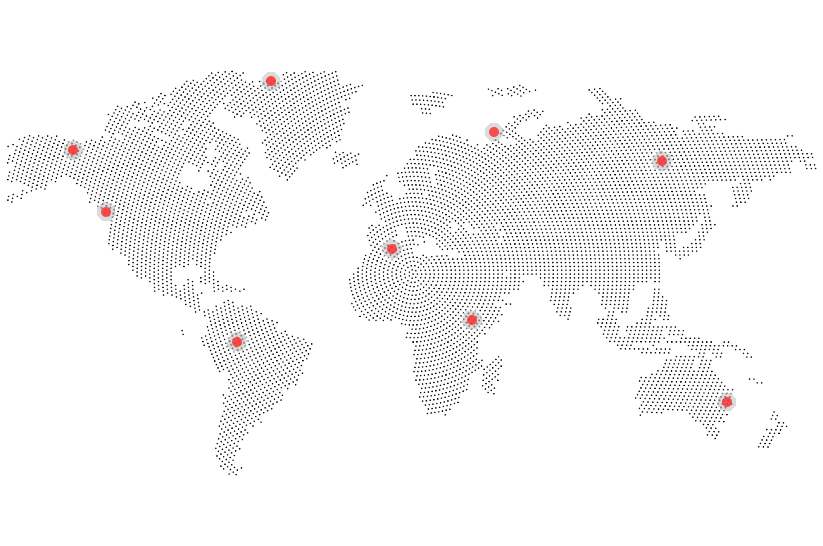
26 August 2026
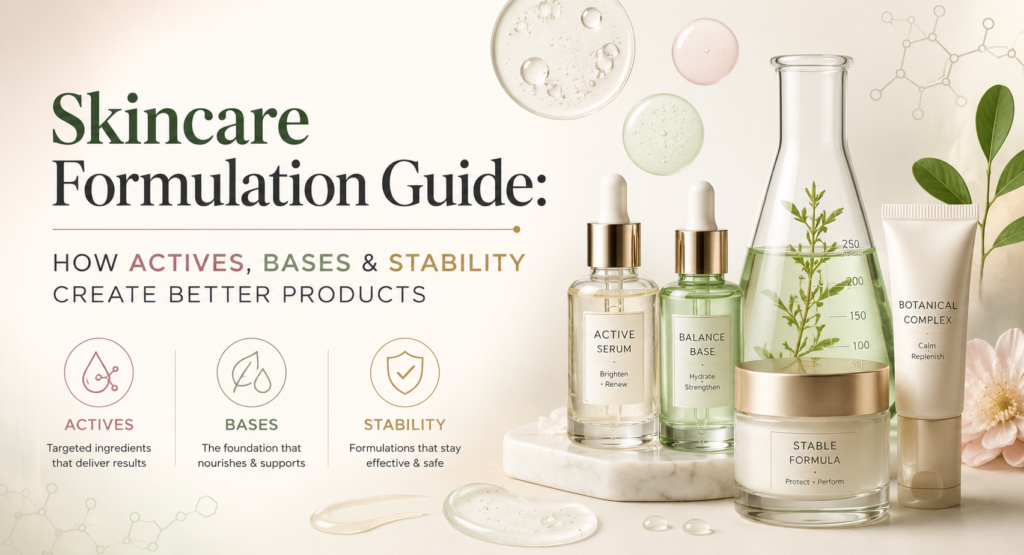
A successful skincare product is not created by simply combining popular ingredients. Behind every effective serum, moisturizer, cleanser, body lotion, or cream is a carefully considered formulation that balances active ingredients, bases, texture, compatibility, preservation, and stability. This is why Skincare Formulation plays such an important role in turning a product idea into something customers can consistently use and trust.
For beauty entrepreneurs, private-label brands, and established cosmetic businesses, understanding the fundamentals of formulation can make product development more strategic. The right ingredients need the right delivery system, while the right formula needs appropriate testing and packaging to maintain its intended quality.
For a company such as Ashwani LLC, which provides cosmetic manufacturing, private labelling, custom formulation, bath and body care, essential and carrier oils, and wholesale supply, formulation is part of a broader product-development journey. Ashwani LLC states that its custom formulation service focuses on creating products around a brand’s requirements, with attention to safety, stability, and longevity.
Skincare Formulation is the process of designing and combining cosmetic ingredients in appropriate proportions to create a finished product with a specific purpose, texture, appearance, and performance.
It involves much more than choosing ingredients from a supplier catalogue. A formulator needs to understand how ingredients behave individually and how they interact within the complete formula.
For example, a skincare product may contain:
The goal is to make these components work together as a balanced system rather than simply creating a long ingredient list.
A product can contain highly desirable ingredients and still fail to deliver a good customer experience if the formulation is poorly designed. Separation, unpleasant texture, instability, discoloration, changes in odor, or incompatibility between ingredients can affect the finished product.
Good formulation helps brands focus on several areas at once:
Performance: The formula should support the product’s intended cosmetic purpose.
Safety and suitability: Ingredients and concentrations need to be selected appropriately for the intended product and users.
Stability: The product should maintain its intended characteristics throughout its expected shelf life when stored appropriately.
Sensory experience: Texture, absorption, spreadability, fragrance, and finish all influence how customers perceive a product.
Brand differentiation: A thoughtfully developed formula can help a brand create a product with a more distinctive identity.
For private-label businesses, these factors can be especially important because the product itself becomes part of the brand’s reputation.
Skincare actives are ingredients selected for specific cosmetic functions. They are often the ingredients that give a product its main marketing story, but selecting them should begin with the product’s purpose rather than the latest trend.
Commonly used skincare actives include:
Niacinamide is widely used in skincare products designed around skin conditioning, hydration, and the appearance of more balanced skin.
Hyaluronic acid is a popular humectant used in products focused on hydration and a plumper-looking skin appearance.
Vitamin C and its derivatives are commonly incorporated into formulations positioned around antioxidant care and brighter-looking skin.
Retinoid-based ingredients are frequently used in products targeting the appearance of fine lines, uneven texture, and signs associated with skin aging. Their formulation requires careful consideration because different retinoid ingredients have different stability and usage requirements.
Alpha hydroxy acids and beta hydroxy acids are commonly used in exfoliating products. Their concentration, pH, product format, and overall formulation require careful consideration.
Peptides are used in various cosmetic formulations designed around the appearance of smoother and firmer-looking skin.
Plant extracts, carrier oils, and other botanical ingredients can contribute functional and sensory characteristics to a product. However, “natural” or “organic” positioning does not eliminate the need for appropriate formulation, testing, preservation, and quality control.
The important principle is simple: choose ingredients because they make sense for the product, not simply because they are popular.
If actives provide much of a product’s functional story, the base provides its foundation. It affects texture, spreadability, absorption, appearance, stability, and overall user experience.
Different product formats require different formulation approaches.
Creams are commonly structured as emulsions containing water and oil phases. They can range from lightweight facial moisturizers to richer creams for dry-feeling skin.
Gels are often associated with lightweight, refreshing textures. They can work well for products where a non-greasy and fast-absorbing feel is desired.
Serums can be water-based, oil-based, or emulsion-based. They are often designed around concentrated ingredient systems and lightweight application.
Lotions generally offer a lighter texture than many creams and are widely used in facial and body care.
Oil-based products can be used for facial care, body care, cleansing, massage, and other applications. Their formulation needs to account for oxidation and compatibility with the selected packaging.
Choosing the right base is not simply a matter of preference. It depends on the active ingredients, target customer, desired product experience, packaging, manufacturing process, and stability requirements.
One of the biggest formulation challenges is making the active ingredients and base work together.
An active may have specific requirements relating to solubility, pH, temperature, light, oxygen, or concentration. The base must accommodate those requirements without compromising texture or stability.
A professional formulation process therefore considers:
Adding more actives does not automatically make a better product. A well-balanced formula is generally more valuable than an overloaded ingredient list.
A formula that looks perfect immediately after production may change over time. Stability testing helps evaluate whether a product can maintain its intended characteristics during its expected shelf life under appropriate conditions.
Depending on the formulation, evaluation may consider:
Temperature, light, oxygen, moisture, and packaging can all influence product stability.
For example, an oxidation-sensitive oil may require suitable packaging and protection from environmental exposure. Similarly, a water-containing formulation needs an appropriate preservation strategy and microbiological controls.
Stability evaluation can therefore help identify potential problems before a product reaches large-scale production.
Packaging and formulation should not be treated as completely separate decisions.
A product may need packaging that protects it from light, oxygen, contamination, or repeated exposure to air. The choice between a jar, tube, bottle, dropper, or airless format should consider both brand presentation and formula requirements.
Ashwani LLC provides packaging options including tubes, glass bottles, and glass jars, allowing brands to consider packaging as part of the wider product-development process.
For a private-label brand, this integrated approach can simplify development because formula, packaging, filling, labeling, and manufacturing can be coordinated rather than managed through multiple disconnected suppliers.
Brands generally have two broad approaches when developing skincare products.
Ready-made or white-label formulas can provide a faster route to market. They are useful for businesses that want to test a category, launch quickly, or begin with a lower development commitment.
Custom formulation, on the other hand, allows a brand to develop a product around specific ingredients, textures, target customers, and positioning.
Custom formulation may be especially valuable when a brand wants a distinctive product rather than a formula that could also be available to multiple businesses.
Ashwani LLC describes a six-step custom formulation process covering formulation, sampling, approval, budgeting, packaging, and final product development.
This structured approach allows brands to move from an initial idea toward a more clearly defined finished product.
Launching a skincare brand does not necessarily require building your own manufacturing facility. With private label cosmetics manufacturing, brands can work with an experienced manufacturer to develop or select products and sell them under their own brand identity.
Private labelling can help businesses access:
Ashwani LLC offers private-label solutions for cosmetics, skincare, personal care, natural cosmetics, hair care, home care, soaps, aromatherapy products, and related categories.
For startups, this can provide a practical way to enter the market without investing in an entire manufacturing operation from day one.
The same formulation principles extend beyond facial skincare. Bath and body care products also require careful decisions around ingredients, bases, texture, fragrance, preservation, stability, and packaging.
Popular categories include:
Ashwani LLC’s product range includes bath and body care products such as moisturizers, face creams, face washes, serums, scrubs, and skincare sets.
This creates opportunities for brands to build a broader personal-care portfolio rather than limiting themselves to one skincare category.
Consumer interest in pure and organic beauty products has encouraged brands to explore natural oils, botanical extracts, and plant-derived ingredients. However, a natural ingredient still needs to be evaluated based on its quality, compatibility, stability, intended use, and formulation behavior.
For example, natural oils can contribute conditioning and sensory properties, but some oils can be susceptible to oxidation. Botanical ingredients can also vary in composition depending on their source and processing.
Ashwani LLC highlights a range of pure and organic essential and carrier oils alongside natural cosmetics and personal-care products.
For brands using natural positioning, the objective should be to combine ingredient quality with sound formulation practices, rather than treating “natural” or “organic” as a substitute for product development and testing.
For growing beauty brands, selecting a reliable wholesale supplier is as important as selecting the right formulation.
Before partnering with a supplier, consider:
Ashwani LLC operates as a B2B manufacturer and wholesale supplier, offering bulk essential and carrier oils as well as finished cosmetic and personal-care products. Its website states that bulk quantities can range from 25 kg to 200 kg and above depending on the product.
For businesses that need both raw materials and finished products, having these capabilities under one supplier relationship can simplify procurement and supply-chain management.
A successful skincare product needs more than an attractive concept. It needs a development process that connects ingredients, formulation, testing, packaging, manufacturing, and brand positioning.
Ashwani LLC provides custom formulation and private-label support designed to help brands move through these stages. Its stated process begins with formulation or formula selection, followed by sampling, approval, budgeting, packaging, and final production.
This can be particularly useful for businesses developing skincare, bath and body care, natural cosmetics, essential-oil products, and other personal-care ranges.
Instead of treating formulation and manufacturing as isolated steps, brands can approach product development as one connected process—from the first product idea to the final packaged product.
The foundation of a better skincare product is not the number of ingredients on its label. It is how thoughtfully those ingredients are selected, combined, tested, packaged, and manufactured.
Effective Skincare Formulation brings together actives and bases while considering compatibility, sensory experience, stability, preservation, packaging, and the needs of the target customer. For brands interested in private label, bath and body care, or pure and organic product lines, choosing the right development and wholesale partner can make the journey more efficient and scalable.
With its focus on custom formulation, private labelling, cosmetics, bath and body care, natural products, essential and carrier oils, packaging, and wholesale supply, Ashwani LLC can support brands looking to transform product concepts into professionally developed cosmetic and personal-care ranges.
Skincare Formulation is the process of selecting and combining cosmetic ingredients in appropriate proportions to create a product with a specific purpose, texture, stability, and user experience.
Active ingredients are selected for specific cosmetic functions, such as supporting hydration, improving the appearance of skin tone, or promoting a smoother-looking complexion.
An active is generally selected for a particular cosmetic benefit, while the base provides the formulation’s structure, texture, delivery environment, and sensory characteristics.
Stability testing helps determine whether a formulation can maintain its intended appearance, texture, consistency, and other quality characteristics throughout its expected shelf life.
Yes, natural and organic ingredients can be incorporated into suitable formulations. However, their compatibility, quality, stability, intended use, and applicable product requirements still need to be considered.
Private-label skincare manufacturing allows a business to sell skincare products under its own brand while a third-party manufacturer develops or produces the products. The level of customization can vary depending on the manufacturer’s services.
Yes. Ashwani LLC states that it offers custom formulation services, allowing brands to select existing formulas or request products developed according to their requirements.
Yes. Ashwani LLC identifies itself as a B2B manufacturer and wholesale supplier of products including essential oils, carrier oils, cosmetics, bath and body care, and related personal-care products.
Yes. Its product range includes bath and body care products such as moisturizers, face creams, face washes, serums, scrubs, and skincare sets.
The process can begin by defining your product concept, target audience, desired ingredients or benefits, packaging preferences, and market requirements. Ashwani LLC’s stated process then moves through formulation, sampling, approval, budgeting, packaging, and final production.
