

Our Global export market
We provide our services all over the world. Where we can serve you ?
Contact Us
5 September 2026
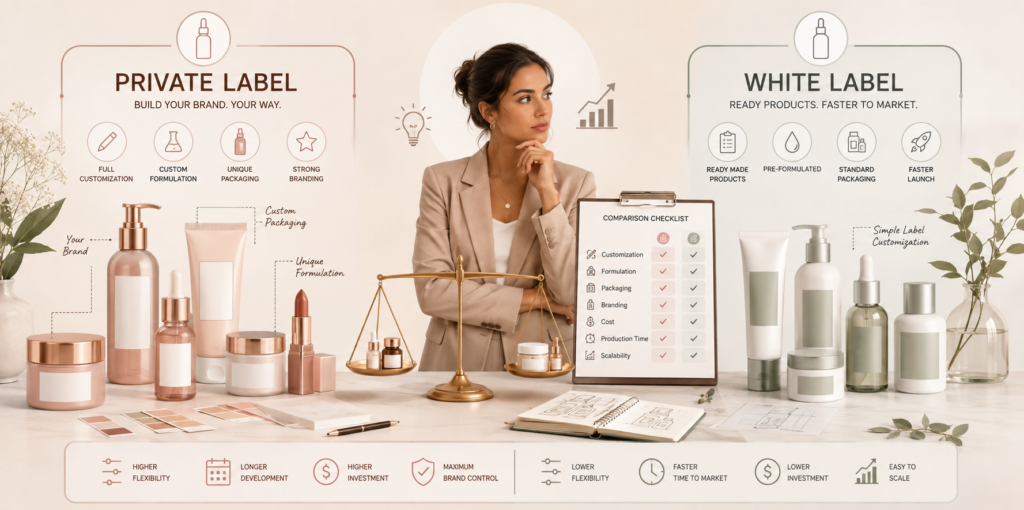
Choosing the right manufacturing path can make or break a beauty business. If you are looking to break into the booming beauty industry and figuring out how to launch a beauty brand, you have likely come across two terms: white label cosmetics and private label cosmetics.
While many beauty brand founders treat these terms interchangeably, they are fundamentally different cosmetics manufacturing models. Choosing the wrong one can lock your business into rigid formulation limits or drain your startup budget prematurely.
At Ashwani LLC, we specialize in helping businesses navigate complex supply chains and branding strategies. This comprehensive guide breaks down the structural differences, financial implications, and strategic advantages of Private Label vs. White Label Cosmetics so you can confidently choose the model that fits your brand.
White label cosmetics are pre-made, off-the-shelf beauty products created by a third-party manufacturer. The manufacturer develops a single, standardized formulation and sells it to multiple different brands.
As the buyer, you do not change the product itself. Instead, you simply customize the external packaging, apply your custom label, and market it under your own brand identity.
Private label cosmetics take beauty product customization a step further. In this model, you partner with a manufacturer to build a more proprietary product.
While you may start with an existing base formula provided by the manufacturer, you have the flexibility to customize its core characteristics. You can request specific ingredient tweaks, change the fragrance or texture, alter the color pigment, or build the product around specific claims like vegan, organic, or cruelty-free certifications.
To maximize scannability, here is how the two models stack up across key business vectors:
| Feature | White Label Cosmetics | Private Label Cosmetics |
| Formulation Ownership | Formulations are 100% owned by the factory; non-exclusive. | Modifiable formulations; option for contract exclusivity or IP ownership. |
| Level of Customization | Restricted strictly to external packaging and label design. | High; control over scent, texture, color, and active ingredients. |
| Average MOQs | Low (typically 100 – 500 units). | Moderate to High (typically 1,000 – 3,000+ units). |
| Time-to-Market | Fast (2 to 6 weeks). | Slow (3 to 9+ months due to sampling and R&D). |
| Upfront Financial Risk | Low; ideal for bootstrapping or initial testing. | Higher; requires capital for R&D and bulk inventory. |
| Retail Viability | Difficult; major retailers demand unique product values. | High; built-in exclusivity satisfies premium retail buyers. |
When budgeting for a cosmetics launch, many founders fall into the trap of looking exclusively at the Cost of Goods Sold (COGS) or the per-unit price quoted by the factory. However, the true cost of bringing a beauty product to market involves several hidden operational expenses that vary wildly between manufacturing models.
With white label cosmetics, the per-unit cost is often higher, but the ancillary fees are virtually non-existent. You are paying for a turnkey product. Conversely, private label cosmetics offer a much lower per-unit price at high volumes, but they require significant upfront capital before a single bottle is filled.
At Ashwani LLC, we advise clients to audit these hidden cost centers before signing a manufacturing agreement:
To understand the long-term financial viability of your beauty brand, you must look at how your manufacturing choice dictates your gross profit margins. Let’s look at a simulated financial comparison using realistic industry figures for a premium Vitamin C Facial Serum retailing at a competitive price point of $45.00.
| Financial Metric | White Label Approach | Private Label Approach |
| Target Retail Price | $45.00 | $45.00 |
| Initial Minimum Order Quantity (MOQ) | 250 units | 2,000 units |
| Upfront R&D & Setup Fees | $0.00 | $3,500.00 |
| Per-Unit Manufacturing Cost | $9.50 | $4.25 |
| Total Inventory Production Cost | $2,375.00 | $8,500.00 |
| Total Initial Capital Required | $2,375.00 | $12,000.00 |
| Gross Profit Margin Per Unit | 78.8% ($35.50) | 90.5% ($40.75)* |
While the white label model requires significantly less initial capital ($2,375 vs. $12,000), your profit scaling is capped. The private label model unlocks an incredibly lucrative 90.5% gross margin. This extra margin gives your brand the financial cushion needed to fund aggressive digital marketing campaigns, offer influencer commissions, or absorb seasonal promotional discounts without eroding your bottom line.
White labeling is an exceptional tool for validation, but it features a built-in expiration date for growing brands. As your monthly sales volume increases, the high per-unit cost of white labeling begins to work against you, creating what supply chain experts call margin drag.
Consider this timeline: When you are selling 100 bottles a month, a $9.50 per-unit cost is highly manageable. However, when your brand scales to selling 2,500 bottles a month, continuing with a white label factory means you are effectively overpaying by thousands of dollars every single month compared to what you would pay under a private label contract.
At this inflection point, the capital you save on low MOQs is completely eclipsed by lost profit potential. If your brand is consistently moving more than 500 units per month per SKU, it is time to transition away from white label catalogs and scale into custom private label manufacturing to protect your margins.
Your manufacturer is the most critical partner in your supply chain. A bad factory relationship can result in ruined product batches, missed retail deadlines, and legal liabilities.
When vetting potential manufacturing partners, Ashwani LLC recommends bypassing the sales pitch and demanding concrete answers to these five operational questions:
Understanding why factories enforce Minimum Order Quantities (MOQs) will help you negotiate better contracts. Factories do not set MOQs to be difficult; they set them because setting up industrial cosmetic machinery is an expensive, time-consuming process.
Before a factory can run a batch of your custom private label moisturizer, industrial vats must be completely disassembled, sanitized to medical standards, reassembled, and calibrated for filling weights. If a factory ran a batch of only 50 custom bottles, they would lose thousands of dollars in operational downtime.
Supply chain predictability is vital for maintaining consistent inventory levels. A stock-out on your website can permanently kill your momentum and alienate your customer base.
One of the most legally complex areas of the beauty business is cosmetics formulation ownership. Many founders mistakenly assume that because they paid a factory to customize a private label formula, they own that formula. This is rarely the case.
In standard private label contracts, the manufacturer retains ownership of the intellectual property (IP). They are granting you an exclusive or non-exclusive right to sell their formula under your brand name, but you do not own the exact chemical recipe or the percentages of ingredients.
If you decide to leave that manufacturer because they raised their prices or suffered quality issues, you cannot legally take that formula to a competitor factory. You would have to start from scratch with a new chemist. At Ashwani LLC, we help rising brands structure clear manufacturing agreements that explicitly outline IP buy-out clauses or formulation escrow terms, ensuring your long-term brand equity remains protected.
No matter how beautiful your packaging is, if your product causes an adverse skin reaction or grows mold on a consumer’s bathroom shelf, your brand is finished. The beauty industry is heavily regulated, and staying compliant is a non-negotiable requirement.
Any time you alter a formulation via private label manufacturing, you trigger the need for rigorous safety testing protocols. You cannot simply mix ingredients together and sell them immediately.
White label products have already cleared these hurdles, making them ideal for an immediate, worry-free launch. Private label products require you to factor these multi-month testing windows into your launch calendar.
Modern beauty consumers are highly educated. They read ingredient labels carefully and demand strict ethical compliance, such as clean, vegan, gluten-free, and cruelty-free certifications.
However, translating marketing concepts into concrete lab formulas can lead to unexpected ingredient traps. For example, a white label catalog might advertise a “natural cream,” but upon closer inspection of the ingredient deck, it may contain synthetic fragrances or palm oil that violates your brand’s strict environmental standards.
When pursuing a private label strategy, you have the power to audit the supply chain of every raw active ingredient. You can mandate the use of RSPO-certified sustainable palm oil, specify synthetic mica to avoid child labor in mining chains, or completely eliminate animal-derived byproducts like carmine or beeswax.
Building a clean beauty brand requires deep laboratory transparency. Ashwani LLC works alongside brand founders to decode complex chemical terminology, ensuring your product’s ingredient deck completely aligns with your marketing promises.
Neither manufacturing model is universally better than the other; the right choice depends entirely on your brand’s current phase, budget, and ultimate long-term vision.
Deciding between white label and private label cosmetics is not a matter of choosing which model is universally superior; it is about aligning your production capabilities with your current capital, timeline, and long-term business goals.
If you are a solo entrepreneur, an established spa owner, or a brand founder looking to quickly test market demand with minimal financial exposure, white label manufacturing provides the ultimate low-risk, rapid-launch springboard. However, if your long-term goal is to build a highly defensible, premium beauty brand with unique ingredient narratives, high gross profit margins, and a footprint in global retail spaces like Sephora or Ulta, investing in private label manufacturing is a foundational necessity.
In the fast-moving beauty industry, miscalculating your manufacturing strategy can result in lost profit margins, dead inventory, or legal vulnerabilities. Partnering with a specialized supply chain consultant ensures you navigate these complex operational decisions smoothly. Contact Ashwani LLC today to build an optimized, scalable manufacturing strategy tailored directly to your brand’s vision.
The primary difference is formulation exclusivity. White label cosmetics utilize a pre-existing, ready-made formula sold to multiple brands simultaneously, altering only the external packaging. Private label cosmetics allow for customization of the core formula (such as adjustments to color, scent, and active ingredients) to create a more proprietary product.
The white label model is significantly cheaper for an initial launch. Because the formulations are already developed and tested, white label manufacturers offer much lower Minimum Order Quantities (MOQs)—often starting at just 100 to 500 units—eliminating expensive upfront Research & Development (R&D) and testing fees.
Yes. White label manufacturers explicitly produce formulations for this exact purpose. When you purchase white label products, you buy the legal right to apply your custom branding, logo, and external packaging to their stock formulas and sell them as your own.
In standard private label agreements, the manufacturer retains the Intellectual Property (IP) and ownership of the formulation. Unless you negotiate a specific IP buyout clause or pay for 100% custom contract manufacturing from scratch, you cannot legally take that exact formula to a competitor factory.
Private label MOQs are typically higher (usually 1,000 to 3,000+ units) because the factory must alter its machinery and mix a standalone, custom batch specifically for your brand. This process requires significant operational downtime for machine cleaning, sanitization, and calibration.
Launching a private label product generally takes anywhere from 3 to 9+ months. This timeline accounts for back-and-forth product sampling, stability testing, microbial challenge testing, and custom packaging production.
No, not by the buyer. The manufacturer has already completed all mandatory stability, safety, and compatibility testing for their stock catalog. This pre-cleared compliance is one of the main reasons white label products can be brought to market in a matter of weeks.
Only if the manufacturer’s stock formulation has already officially achieved those specific certifications. You cannot legally claim a product is organic or cruelty-free on your packaging unless the manufacturing facility holds the documented supply chain certifications to back up those explicit marketing claims.
Yes, and this is a highly recommended scaling strategy. Many founders launch with white label products to validate their target audience and generate early revenue. Once the brand achieves consistent sales volume (typically exceeding 500 units per SKU per month), they reinvest their profits into private label manufacturing to secure better profit margins and formulation uniqueness.
At Ashwani LLC, we conduct a comprehensive audit of your operational capital, design timeline, and brand strategy. We help you negotiate manufacturing agreements, navigate complex FDA regulatory compliance, minimize supply chain bottlenecks, and select the exact production model that protects your long-term brand equity.
