

Our Global export market
We provide our services all over the world. Where we can serve you ?
Contact Us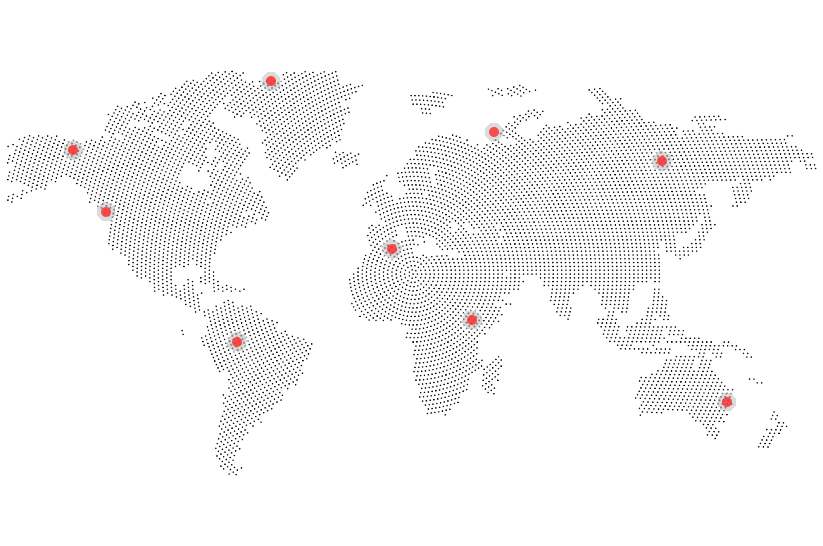
23 July 2026
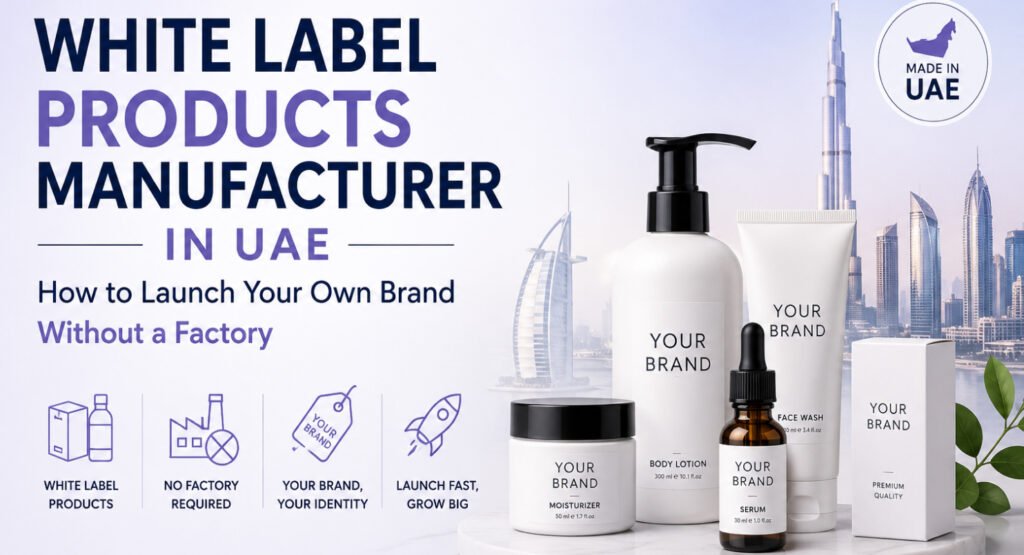
You can launch your own product brand in the UAE without owning a single piece of manufacturing equipment. A white label products manufacturer in UAE handles the entire production side, from formulation to packaging, while you focus on building the brand, growing your customer base, and making sales. It’s one of the most capital-efficient ways to enter the UAE’s booming beauty, wellness, and personal care market. The UAE beauty and personal care market was valued at approximately USD 3.29 billion in 2025 and is projected to reach USD 4.68 billion by 2031, growing at a 6.05% CAGR (Mordor Intelligence, 2026). That’s a huge window of opportunity. And with the right white label manufacturing partner, you don’t need a factory, a lab, or a team of chemists to claim your share of it.
In my decade working with brands across the Gulf, I’ve seen founders spend years and hundreds of thousands of dirhams trying to build manufacturing from scratch. Most of them eventually realize they should have started with white labeling. This guide walks you through exactly how to do it.
White label manufacturing is a model where a manufacturer produces a finished product, and a brand purchases it, applies their own branding and packaging, then sells it as their own. The product itself is generic in origin but becomes exclusively “yours” in the market through branding.
White label manufacturing is distinct from private label in one subtle but important way. In a strict sense, white label products are pre-made items available to multiple buyers simultaneously, while private label products are produced specifically for one brand and often involve some level of customization. In practice, especially in the UAE market, the two terms are used interchangeably, and most UAE manufacturers offer both on a spectrum from zero customization to full formula development.
Here’s how the process typically works in the UAE:
The whole cycle, from first conversation to finished goods, typically takes 2 to 6 weeks for white label products with stock packaging.
The UAE isn’t just a good market for white label brands. It’s arguably one of the best in the world right now, and here’s why that statement holds up.
First, the consumer base is uniquely diverse. Dubai alone has residents from over 200 nationalities, which means a white label brand can test products across multiple consumer profiles within a single city. You don’t need to go global to learn global consumer behavior; the UAE gives you that in one market.
Second, the re-export opportunity is exceptional. Brands built in the UAE routinely export to Saudi Arabia, Kuwait, Bahrain, Qatar, and Oman under Gulf Cooperation Council (GCC) trade agreements. A product registered and compliant in Dubai has a clear pathway to the broader GCC market of over 57 million consumers.
Third, the cost of launching here is lower than in Europe or North America when you factor in free zone business setup, minimal import tariffs on raw materials, and access to manufacturers who already hold Dubai Municipality (DM) product registration support.
According to a 2025 Mordor Intelligence report, facial cosmetics alone captured 47.92% of the UAE cosmetics market share in 2025, while natural and organic product lines are growing at 5.79% CAGR through 2031. Those figures matter when you’re picking your white label product category.
Fourth, UAE consumers are willing to spend. The average UAE resident spends among the highest per-capita figures in the Arab world on beauty and personal care, making it a market where well-branded white label products can command genuine price premiums.
This is where many first-time brand founders are surprised. The range of white label products available through established UAE manufacturers goes far beyond basic moisturizer and shampoo.
At Ashwani LLC, for example, the product categories available for white labeling include:
Skincare and cosmetics:
Bath and body products:
Essential and carrier oils:
Aromatherapy and wellness products:
Ceramic and aroma accessories:
The breadth matters because your white label brand doesn’t have to be a single product. Many of the most successful UAE wellness brands launch with a cohesive range: an essential oil, a matching body lotion, and a ceramic diffuser, all from one supplier, all under one brand. That’s a complete gifting and retail proposition from day one.
You can explore the full product range available for white labeling at Ashwani LLC’s product pages to get a sense of what’s already available.
Choosing the wrong manufacturer is the most expensive mistake you can make at the launch stage. And it’s more common than you’d think.
Here are the criteria that actually matter when vetting a white label products manufacturer in UAE:
At minimum, your manufacturer should hold ISO 9001 or ISO 22716 (GMP for cosmetics). For products sold in the UAE, Dubai Municipality (DM) cosmetic notification is mandatory. Ask the manufacturer directly whether they support DM registration or whether that responsibility falls on you. Unregistered cosmetics can be confiscated at the border.
For brands targeting the wider GCC market, halal certification is worth asking about. A growing portion of GCC consumers specifically look for halal-certified personal care products, and having that certification from the start is far easier than adding it later.
This is where a lot of startups get burned. A manufacturer with a 5,000-unit MOQ is not the right partner for a brand launching its first SKU. Look for manufacturers that offer starting quantities of 100 to 500 units for white label products. This lets you test the market without overcommitting capital.
Ashwani LLC works with over 600 formulations and has served brands across 195 countries, with MOQ structures designed for businesses at every growth stage.
If your brand vision involves multiple product categories (say, a wellness brand combining essential oils, a body care range, and ceramic diffusers), you want a single supplier who can handle all of them. Multi-supplier complexity kills operational efficiency early in a brand’s life.
Your manufacturer should either offer in-house packaging or have established supplier relationships for custom packaging. The packaging is your brand’s face to the customer. Stock bottles with peel-and-stick labels work at launch; custom glass with embossed caps create the premium shelf presence that supports higher retail prices.
Our packaging services page covers what custom cosmetic packaging looks like in practice, from tubes and bottles to glass jars and gift sets.
If you plan to sell beyond the UAE, your manufacturer needs export experience. This includes familiarity with ESMA (Emirates Authority for Standardization and Metrology) requirements, Gulf Standardisation Organisation (GSO) standards, and documentation required by Saudi SFDA, Kuwait’s Ministry of Commerce, and equivalent bodies.
Let’s talk about real numbers, because the vague estimates on most websites don’t help anyone plan a business.
Here’s a realistic cost breakdown for white label skincare in the UAE market as of 2026:
| Cost Item | Typical Range (AED) |
| Sample selection / product testing | 0 to 500 per sample |
| White label MOQ (100 to 500 units) | Varies by product |
| Per-unit cost: basic body care | 8 to 20 per unit |
| Per-unit cost: face serum / premium care | 20 to 60 per unit |
| Custom label printing (per run) | 200 to 800 |
| Stock bottle packaging (per unit) | 2 to 10 |
| Custom packaging (per unit at MOQ) | 8 to 25 |
| Dubai Municipality notification | 1,000 to 3,500 per product |
| Brand registration / trademark (UAE) | 8,000 to 15,000 one-time |
For a brand launching 3 to 5 SKUs with stock packaging on initial orders of 200 units per SKU, you’re typically looking at a total outlay of AED 25,000 to 60,000 for your first batch. That’s significantly less than the AED 200,000 to 500,000 cost of setting up even a small manufacturing operation.
The per-unit cost drops meaningfully as volume increases. A moisturizer that costs AED 18 per unit at 200 units might come down to AED 9 per unit at 2,000 units. That’s the economics of white labeling working in your favor as your brand grows.
I’ve walked more than a few brand founders through this process. Here’s the sequence that actually works.
Step 1: Define your brand and product niche. Decide on your category (skincare, wellness oils, aromatherapy, bath and body), your target customer, and the positioning you want (luxury, natural, clinical, eco-friendly, halal). The clearer this is, the faster you’ll move.
Step 2: Research and shortlist UAE manufacturers. Look for manufacturers who are government-recognized, ISO-certified, and have a product catalogue that matches your brand vision. Request samples before committing. Any reputable manufacturer will send you samples.
Step 3: Test samples against your brand standards. Smell, texture, stability, how a cream applies to skin, how an oil disperses in a diffuser. These are tactile judgments that no spec sheet replaces. If you can’t personally vouch for a product, don’t put your brand name on it.
Step 4: Confirm MOQ, pricing, and lead times. Get everything in writing: per-unit cost, payment terms, lead time from order to delivery, and who owns the formula.
Step 5: Design your packaging and label. This is where your brand identity becomes tangible. Work with a designer who understands cosmetic labeling compliance in the UAE. Labels must include ingredient lists (INCI format), manufacturer details, country of origin, net weight, and batch codes.
Step 6: Register your product with Dubai Municipality. This is non-negotiable for selling in the UAE. Some manufacturers include DM notification in their service. If not, engage a regulatory consultant. Budget 4 to 8 weeks for this process.
Step 7: Place your first production order. Start small. You’ll learn more from your first 200 customers than from any market research.
Step 8: Build your sales channels. UAE options include your own e-commerce site, Amazon.ae, Noon, concept stores in Dubai and Abu Dhabi, pop-up markets, and direct-to-consumer through Instagram and TikTok. Many successful UAE brands start with social and grow into retail.
For more on the brand setup journey, our blog on how to start an aromatherapy and wellness brand in Dubai covers the regulatory and business registration side in detail.
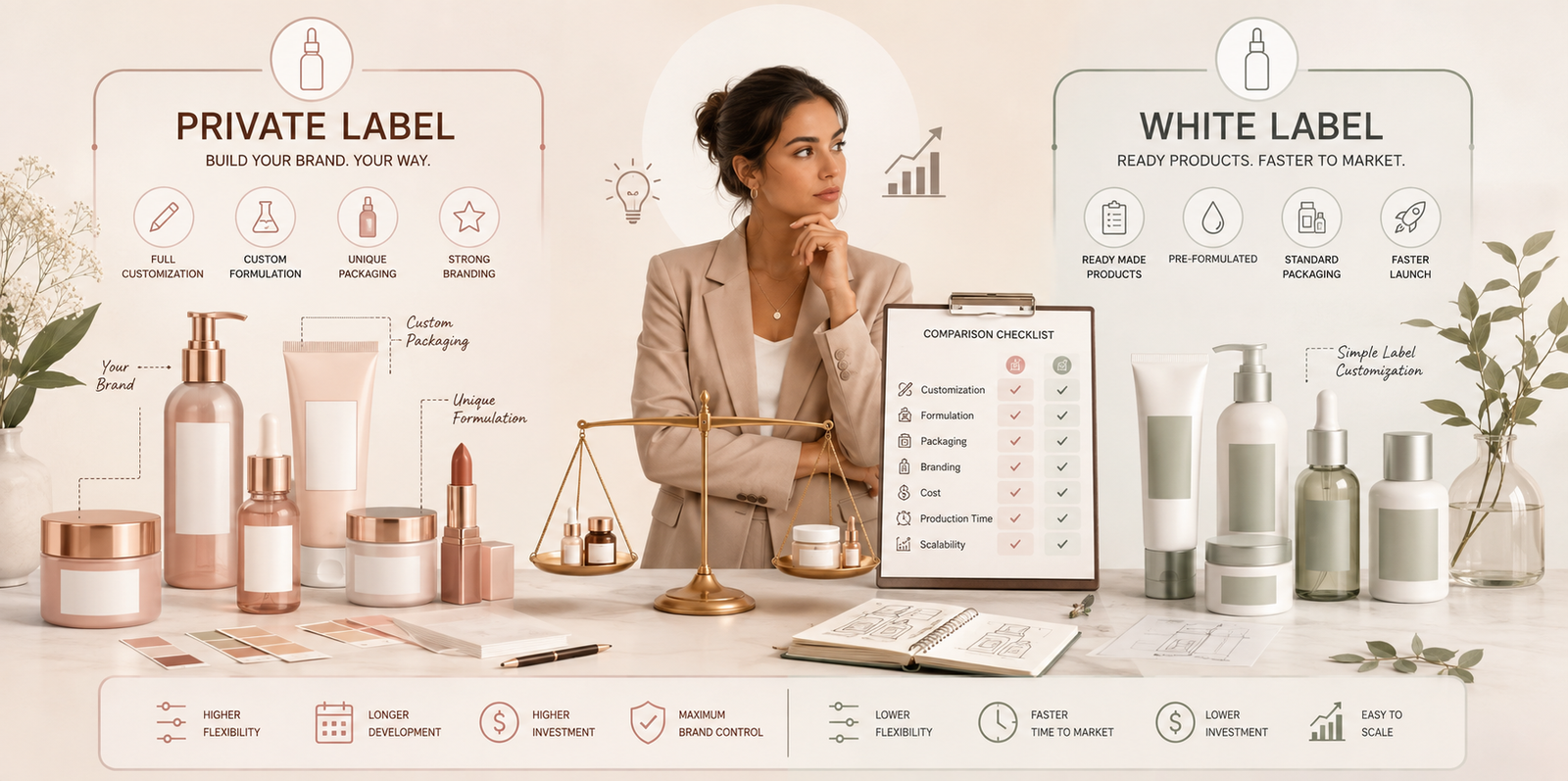
This question comes up in almost every conversation I have with new brand founders. The short version is this: in the UAE market, they’re treated as close siblings rather than completely different models, but understanding the distinction helps you have better conversations with manufacturers.
| Feature | White Label | Private Label |
| Product origin | Pre-made, off-catalogue | Often customized for you |
| Formula ownership | Manufacturer | Manufacturer (often exclusive use) |
| Customization level | Low to medium (packaging) | Medium to high |
| Speed to market | Fastest (2 to 4 weeks) | Fast to medium (3 to 8 weeks) |
| MOQ | Lowest | Low to medium |
| Best for | First-time launches, test products | Growing brands seeking differentiation |
As cosmetics industry expert Mintel’s 2024 Beauty Trends Report noted, brands that start with ready-formulated products and invest early in branding typically reach profitability 40% faster than those that develop formulas from scratch. That’s because formula development is expensive, slow, and carries technical risk. White labeling removes all three of those friction points.
The practical advice: start with white label or private label to validate the market. Once you’ve got proof of demand and a loyal customer base, invest in custom formulation or OEM development to create genuine product differentiation. Our guide on OEM vs. private label vs. contract manufacturing in UAE covers that progression in depth.
Packaging is where most white label brands win or lose in the UAE market. The formula inside the bottle might be identical to a competitor’s, but if your packaging tells a better story, you’ll outsell them every time.
In the UAE specifically, packaging aesthetics track closely with cultural preferences. Consumers across the Gulf respond strongly to clean, elegant design with a premium feel. This doesn’t necessarily mean expensive: a matte white glass jar with a simple embossed logo can feel as luxurious as an ornate custom package, often at a fraction of the cost.
Here’s what matters most for UAE white label packaging:
Ashwani LLC’s cosmetic packaging services include stock and custom options across tubes, bottles, and glass jars, designed specifically for the UAE and GCC retail environment.
Getting compliance right from the start saves you time, money, and significant headaches. Here’s the essential regulatory framework for white label product brands in the UAE.
Dubai Municipality (DM) Cosmetic Notification
All cosmetics and personal care products sold in Dubai must be notified with Dubai Municipality before they go on sale. This includes skincare, body care, hair care, and any product that touches the skin or body. The process requires safety data, formula documentation, and labeling review. Budget 4 to 8 weeks and AED 1,000 to 3,500 per product.
ESMA Registration
For broader UAE distribution (outside Dubai), products may require registration with the Emirates Authority for Standardization and Metrology (ESMA). Your manufacturer should advise on which categories require ESMA registration versus DM notification alone.
Halal Certification
Not legally required for all products, but strongly recommended for brands targeting the broader Muslim consumer base across the GCC. The halal certification process adds 4 to 12 weeks to your launch timeline if pursued from the start.
Trademark Registration
Register your brand name and logo with the UAE Ministry of Economy. This is separate from product registration and protects your brand identity. UAE trademark registration typically takes 6 to 12 months but provides legal protection from day one of filing.
Customs and Import Documentation
If your white label products are manufactured outside the UAE and imported for labeling in Dubai, you’ll need proper HS codes, certificates of origin, and in some cases, free sale certificates from the country of manufacture. Work with a customs broker who understands beauty product classifications.
For a deeper understanding of product types and regulatory categories, our pure and organic products page explains how natural and organic certifications interact with UAE cosmetic regulations.
From auditing supplier relationships across 200+ brand accounts over the years, a few things consistently separate the manufacturers that help brands grow from those that don’t.
Ashwani LLC has been in operation for over 25 years. The company is a Government of India-recognized Star Export House and holds ISO 9001 certification, with products currently distributed across 195 countries. The manufacturing infrastructure covers 100,000+ square meters, with production capacity exceeding 18,000 tonnes annually and access to over 600 formulations across skincare, essential oils, bath and body, and ceramic diffusers.
That scale matters for white label brands because it means:
The company’s private labelling service covers the full journey from product selection and custom packaging through to export documentation. Whether you’re launching a standalone essential oil brand, a full skincare line, or a wellness brand that combines both, the product depth is there.
As one brand founder who launched through Ashwani LLC shared: “Having a manufacturer who already understood the GCC export documentation process saved us four months of regulatory confusion. We launched in Saudi Arabia six weeks after our UAE launch, and they handled everything.”
Launching your own brand through a white label products manufacturer in UAE is genuinely one of the most accessible routes to building a product business in 2026. The market is large and growing, the manufacturing infrastructure in the UAE and from India-based exporters serving the Gulf is mature and capable, and the regulatory pathway is clear if you work with the right partner.
The key takeaway is this: the factory is not your competitive advantage. Your brand, your story, your customer relationships, and your marketing are. A white label manufacturer handles the production; you build the business.
Here’s your practical next step. Don’t spend three months researching before you order samples. Pick two or three product categories that align with your brand vision. Reach out to a manufacturer, request samples, test them yourself, and make a decision based on what’s actually in your hands.
The UAE market rewards speed. Brands that launch, learn, and iterate outperform those that plan endlessly. The white label manufacturing infrastructure in this country exists precisely so that you can move fast without compromising on product quality.
If you’re ready to explore what a white label launch looks like with Ashwani LLC’s product range and export capabilities, contact the team directly. Share your product idea, your target market, and your timeline, and you’ll get an honest, practical conversation about what’s possible and what it costs.
You can also review the wholesale supplier capabilities for brands planning to order in bulk from day one, or browse the bath and body care range for inspiration on what’s already catalogue-ready.
The market is open. The manufacturing is available. All that’s missing is your brand.
A white label products manufacturer in UAE is a company that produces finished goods, such as skincare, essential oils, or bath products, that brands purchase and sell under their own name and packaging. The manufacturer handles formulation, production, and often regulatory support. The brand owner focuses on marketing and sales. It’s the most capital-efficient way to launch a product business in the UAE without owning manufacturing infrastructure.
Start by verifying ISO certification (ISO 9001 or ISO 22716), Dubai Municipality compliance support, and product category breadth. Ask for physical samples before committing to any order. Check how long they’ve been operating, whether they have export experience to GCC markets, and what their minimum order quantities are. Manufacturers with 10 or more years of operation and multi-country export track records are the safest starting point.
You can white label a wide range of products including face serums, body lotions, moisturizers, essential oils, carrier oils, bath salts, body washes, natural soaps, aromatherapy blends, and ceramic diffusers. Leading UAE-based manufacturers like Ashwani LLC offer over 600 formulations across skincare, organic oils, and home fragrance categories, giving new brands significant product range flexibility from a single supplier.
MOQ varies by manufacturer and product type. For white label skincare and personal care products in the UAE, expect starting orders of 100 to 500 units per SKU from established manufacturers. Essential oils and bulk products often have weight-based MOQs, typically starting from 5 to 25 kg. Always confirm MOQ in writing before committing to a manufacturing partner, as this directly affects your startup capital requirements.
A starter white label skincare launch in the UAE, covering 3 to 5 SKUs at 200 units each with stock packaging and DM product registration, typically costs between AED 25,000 and AED 60,000. This is dramatically less than setting up a manufacturing operation. Per-unit production costs for basic body care range from AED 8 to 20; for face serums and premium products, expect AED 20 to 60 per unit. Costs decrease significantly as order volumes grow.
Yes. Every cosmetic and personal care product sold in the UAE must be registered with Dubai Municipality (DM) before going on sale, regardless of whether it’s white labeled, private labeled, or manufactured locally. Some manufacturers include DM notification support in their services. If not, engage a regulatory consultant. Budget 4 to 8 weeks and AED 1,000 to 3,500 per product for this process.
White label products are pre-made by a manufacturer and available to multiple brands, who apply their own branding. Private label products are made specifically for one brand and often involve some degree of customization. In the UAE market, the terms are used almost interchangeably. The practical difference is that white label has faster turnaround and lower MOQ, while private label may offer slightly more product exclusivity and formula customization.
From signing with a manufacturer to having product in hand, a white label launch in the UAE typically takes 3 to 8 weeks. This includes product selection (1 week), packaging design and printing (1 to 2 weeks), production (1 to 2 weeks), and shipping or delivery (1 week). Dubai Municipality product notification can run in parallel but may add 4 to 8 weeks before you can legally sell in UAE retail channels.
Yes. The UAE’s free trade agreements and GCC customs union make it a natural export hub. However, each GCC country has its own product registration requirements. Saudi Arabia requires SFDA (Saudi Food and Drug Authority) registration. Kuwait, Bahrain, and Qatar each have their own notification processes. Work with a manufacturer experienced in GCC export documentation, or engage a regulatory consultant familiar with multi-market GCC compliance.
For most founders, white label is the right starting point. It lets you test your brand concept, build a customer base, and generate cash flow without the 12 to 20 week development timeline and higher upfront cost of custom formulation. Once you’ve validated demand, you can move toward custom formulation or OEM development to create genuine product differentiation. White labeling is a launchpad, not a limitation.
