

Our Global export market
We provide our services all over the world. Where we can serve you ?
Contact Us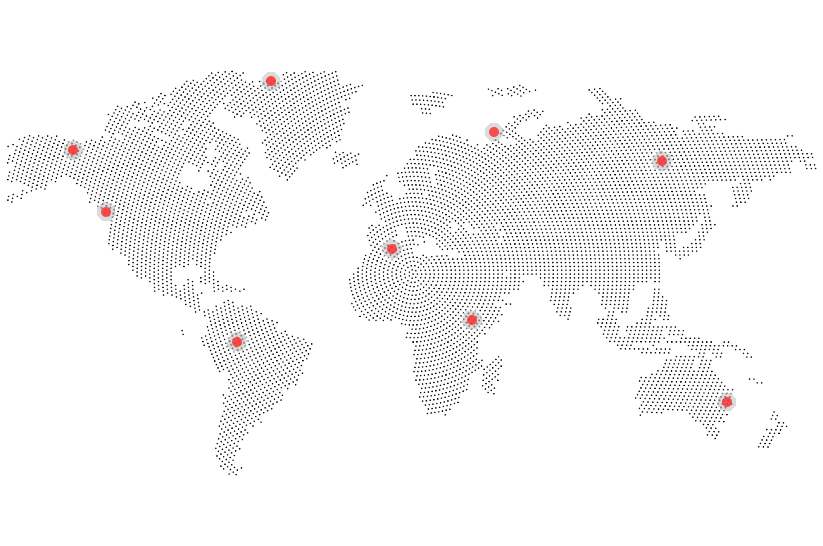
4 May 2026

Most businesses sourcing carrier oils in the UAE make the same mistake: they focus almost entirely on price per kilogram and ignore the variables that actually determine whether a supplier relationship will work long-term. The result? Batches that fail quality checks mid-production, certifications that do not hold up under audit, and minimum order quantities that strain cash flow before a product even reaches market. This guide is written for formulators, cosmetic brand owners, wellness product manufacturers, and procurement managers who want a clear, practical framework for evaluating a bulk carrier oils supplier in UAE. You will learn what quality signals genuinely matter, which certifications carry real weight in 2026, how to navigate MOQ conversations intelligently, and what separates a reliable supply partner from a transactional commodity seller.
Carrier oils are fatty, plant-derived oils used as base or dilution media in cosmetics, aromatherapy, pharmaceutical topicals, and food applications. Common examples include jojoba, sweet almond, rosehip, argan, fractionated coconut, and black seed oil. Unlike essential oils, carrier oils are non-volatile and make up the majority of a finished product by volume, which means their quality, purity, and consistency directly determine the performance and shelf life of everything they go into.
If you are actively building a product line around pure and organic oils, understanding the supply chain behind your raw materials is not optional. It is where product integrity either starts or falls apart.
Sourcing from the UAE, and specifically from a carrier oil wholesaler in Dubai, matters for several practical reasons.
The UAE sits at a geographic and logistical intersection between major producing regions in Asia, Africa, and the Middle East. Dubai in particular operates one of the world’s most efficient free trade zone networks, including Jebel Ali Free Zone (JAFZA), which allows raw materials to be imported, stored, blended, and re-exported with minimal friction. For businesses supplying into GCC markets, Europe, and Southeast Asia, this translates into shorter lead times, lower freight costs, and significantly easier customs documentation than sourcing directly from origin countries in fragmented batches.
Beyond logistics, the UAE regulatory environment has matured considerably. Suppliers operating here are increasingly subject to oversight from the Emirates Authority for Standardization and Metrology (ESMA), Dubai Municipality, and, for export-facing products, international standards bodies. This creates a layer of compliance accountability that is harder to enforce when sourcing from unregulated origin-country suppliers directly.
The carrier oil market has a significant adulteration problem that most supplier directories and wholesale listings do not acknowledge. This is not unique to any region, but it is particularly relevant when sourcing at scale because the economics of dilution become meaningful at bulk volumes.
Common adulteration practices include:
Blending with cheaper base oils. Rosehip oil, argan oil, and sea buckthorn oil are frequently diluted with refined sunflower or soybean oil without disclosure. At small quantities the difference can be difficult to detect organoleptically, but it shows up clearly in gas chromatography (GC) analysis.
Refinement misrepresentation. Cold-pressed oils command higher prices than refined variants. Some suppliers source refined oil and label it cold-pressed. The fatty acid profile may look similar, but the phytochemical content, color, and therapeutic properties differ substantially.
Repackaged private label from unknown origins. Some intermediaries in the UAE are not suppliers at all but repackaging operations. They buy bulk commodity oils, relabel them, and sell without clear chain of custody documentation. This matters enormously if you are building a certified organic, natural, or clean-label product line. Brands who work through a verified wholesale supplier with documented origin and manufacturing transparency bypass this risk entirely.
Understanding these risks should be the starting point for any sourcing evaluation, not an afterthought.
Rather than working from a generic checklist, use the following four-layer evaluation model. Each layer filters a different category of risk.
A credible supplier should be able to provide, without excessive delay or negotiation, the following for every product:
Certificate of Analysis (COA): This should include at minimum specific gravity, refractive index, acid value, peroxide value, saponification value, iodine value, and moisture content. For cold-pressed oils, it should also include a fatty acid profile via GC-MS. A COA that only lists appearance and odor is not a COA, it is a description sheet.
Material Safety Data Sheet (MSDS/SDS): Required for international shipping and professional formulation environments. Its absence signals an unsophisticated or underprepared supplier.
Origin Certificate: This confirms where the raw material was actually cultivated and extracted, not just where it was last processed or bottled.
Batch Traceability Records: The ability to trace a specific batch from its point of purchase back through processing to the source farm or cooperative is a mark of supply chain maturity. Suppliers who cannot provide this are effectively asking you to take origin on faith.
Not all certifications carry equal weight, and some have become so commoditized that they function more as marketing signals than genuine quality guarantees. Here is an honest assessment:
USDA Organic / EU Organic Certification: These remain the most credible organic certifications for products entering Western markets. They require annual third-party audits and full supply chain documentation. If your finished product will carry an organic claim in North America or Europe, insist on this certification at the ingredient level.
ECOCERT / COSMOS Standard: Relevant for natural and organic cosmetic formulations. COSMOS certification is now widely recognized across European and GCC retail buyers. An ingredient supplier with COSMOS-certified organic oils gives your formulation a defensible claim with retail partners.
ISO 9001: This certifies quality management systems, not product quality per se. It tells you the supplier has documented processes and internal audit mechanisms. Useful but insufficient on its own. Suppliers like Ashwani LLC hold ISO 9001 certification alongside FDA-approved manufacturing status, which gives buyers a stronger combined quality assurance baseline.
Halal Certification: Mandatory for products sold into GCC markets and large segments of Southeast Asian and African markets. In the UAE specifically, this is not optional for commercially distributed consumer products. Reputable bodies include ESMA, JAKIM (Malaysia), and MUI (Indonesia).
GMP (Good Manufacturing Practice): Particularly relevant if the supplier is also doing any blending, filling, or processing. GMP compliance means the physical facility and operational procedures meet pharmaceutical or cosmetic manufacturing standards.
One honest note: certification copies can be forged or outdated. Always verify certifications directly through the certifying body’s online registry or by requesting the certificate number and cross-referencing it. A legitimate supplier will welcome this diligence.
Minimum order quantities are where many supplier negotiations break down unnecessarily, because both parties often approach MOQ as a fixed constraint rather than a negotiable parameter with underlying logic.
A supplier sets MOQ based on production run minimums, packaging economics, storage and handling costs, and their own margin requirements at a given volume. Understanding this helps you negotiate more intelligently.
What MOQ to expect from a carrier oil wholesaler in Dubai: For commodity carrier oils like fractionated coconut, sweet almond, or grapeseed, MOQs from a serious wholesaler typically start at 25 to 50 kilograms for standard drum sizes, with pricing tiers at 100 kg, 500 kg, and full IBC (1,000-liter) levels. For specialty oils like rosehip, emu, or sea buckthorn, MOQs may be higher due to limited availability and processing complexity. Reputable suppliers in Dubai, including those offering wholesale supply from 25 kg up to 200+ kg, give buyers structured volume tiers rather than opaque one-size-fits-all pricing.
Red flags in MOQ conversations: Suppliers who will not clearly state their MOQ tiers in writing, who offer dramatically lower MOQs than market standard without explanation, or who change pricing after initial agreement without batch cost justification are all exhibiting behaviors that will create problems at scale.
Practical approach for new buyers: If your volumes are not yet at full wholesale scale, look for suppliers who offer a sample or trial tier (typically 1 to 5 kg) with a COA and then have a clearly structured step-up in pricing toward commercial quantities. This tiered structure is a sign of a supplier designed to grow with customers rather than purely serve large-volume buyers.
This layer is less formal but often the most predictive of how a supplier relationship will actually function.
Communication responsiveness: How quickly and thoroughly does a potential supplier respond to technical questions before you are a customer? Suppliers who are slow, vague, or evasive during the sales process tend to be worse once they have your purchase order.
Shelf life and storage guidance: A knowledgeable supplier will proactively communicate shelf life windows, recommended storage conditions, and whether their oils contain any tocopherol or antioxidant additions (which extend shelf life but must be disclosed for labeling purposes). If they cannot answer basic storage questions, they are selling product, not supplying a material.
Packaging options and fill flexibility: Can they supply in both drum and IBC formats? Can they supply nitrogen-flushed or vacuum-sealed for oxidation-sensitive oils? These capabilities matter for product quality at your end. Suppliers who also offer integrated packaging solutions in glass and pet bottle formats can often reduce your total supply chain complexity by handling both raw material and finished container needs under one roof.
References and client history: A supplier reluctant to provide references or verifiable client relationships is worth treating with caution, particularly for first orders above a few hundred kilograms.
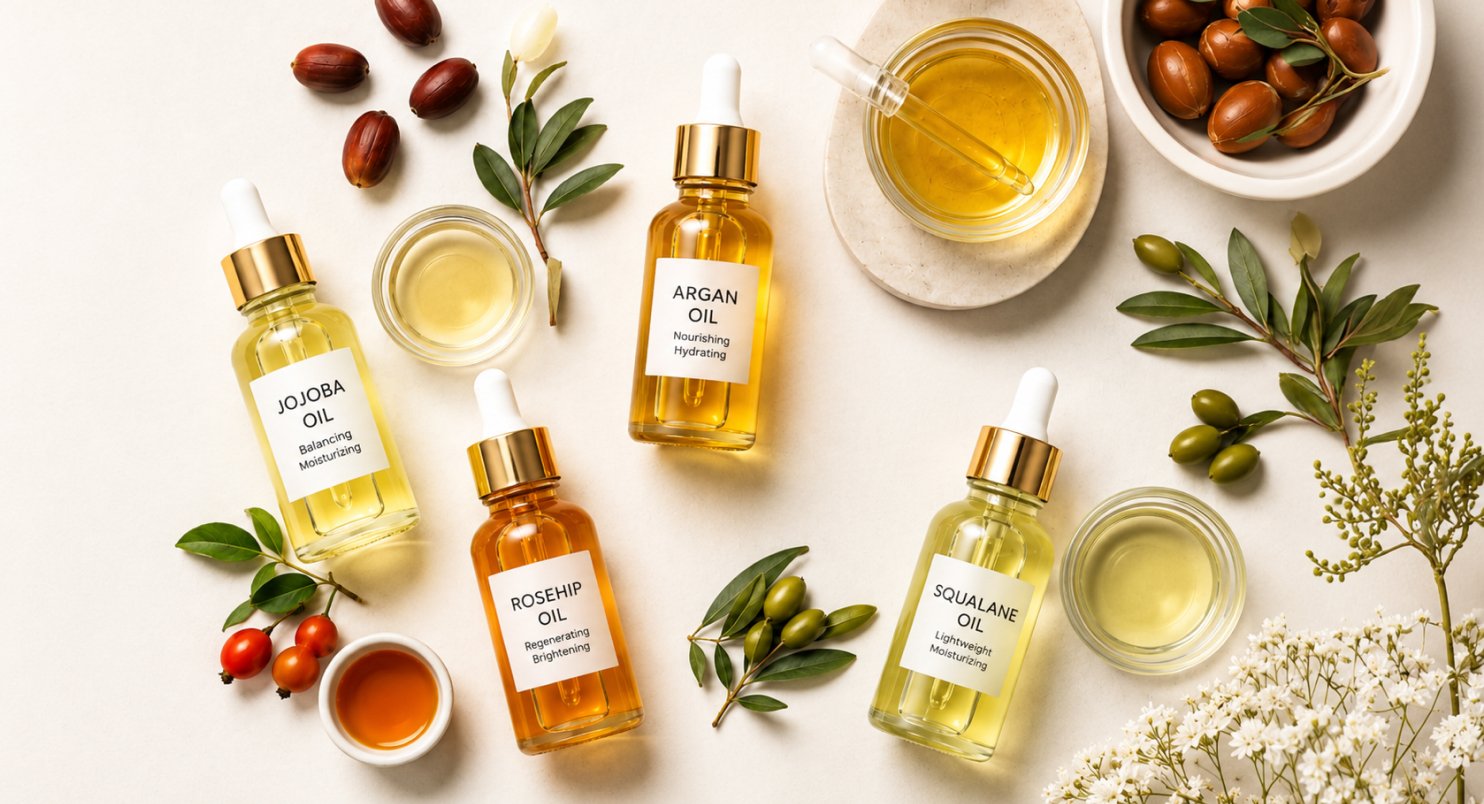
Technically a liquid wax rather than a triglyceride oil, jojoba has an exceptionally long shelf life and closely mimics the skin’s natural sebum. UAE suppliers often source from Israel, Peru, or Argentina. For cosmetic grade, confirm iodine value (82 to 95 is standard for unrefined) and color (golden for unrefined, clear for refined). Adulteration with mineral oil or cheaper waxes is rare but documented.
Morocco is the sole legitimate origin for genuine argan oil. Any supplier claiming argan from another origin should be treated with extreme skepticism. For cosmetic grade, oleic acid content should be 43% to 49% and linoleic acid 29% to 36%. Tocopherol content is a useful marker for freshness and purity. Argan for food use requires a different processing standard than cosmetic grade.
Chile is the primary commercial source. High in trans-retinoic acid (vitamin A) and essential fatty acids. Extremely oxidation-sensitive, meaning it must be stored cold and has a shelf life of six to twelve months depending on tocopherol content and storage conditions. Suppliers who do not mention oxidation stability are not handling this product correctly. If you are formulating anti-aging or regenerative skin serums, rosehip oil sourced from a quality-verified supplier is one of the most defensible ingredient investments you can make.
Significant demand in GCC markets for both topical and internal use. Thymoquinone content is the primary quality marker. Ethiopian origin is generally considered highest quality for black seed oil, though Egyptian and Indian sources are common in UAE supply chains. Cold-pressed and unrefined are standard expectations for therapeutic grade.
One of the most widely used carrier oils in cosmetics globally. Emollient, light-textured, and suitable for sensitive skin formulations. Two main types exist: sweet almond oil (cosmetic and food-grade) and bitter almond oil (used in flavoring, not topical use). Oleic acid typically constitutes 62% to 86% of the fatty acid profile. Widely available in UAE supply chains at competitive wholesale pricing.
A highly refined, odorless, colorless oil consisting primarily of caprylic (C8) and capric (C10) fatty acids. Extremely stable, long shelf life, and widely used in cosmetics, food supplements, and pharmaceutical topicals. Quality is largely standardized, so COA verification and price competitiveness are the primary differentiators between suppliers.
When you receive quotes from multiple suppliers, most buyers compare on price per kilogram and lead time. These are necessary but insufficient comparisons. Use the following matrix to make a more informed decision.
Price per kilogram at your target volume tier, inclusive of packaging and delivery to your location.
Certification status against your specific market requirements (organic, halal, COSMOS, etc.).
COA depth and whether GC-MS fatty acid profiling is included or available on request.
Batch traceability depth (country of origin only vs. full farm or cooperative documentation).
Sample availability and whether samples come with full documentation.
Lead time from order confirmation to delivery.
Packaging format options and whether they can accommodate specialized requirements.
Payment terms and whether they offer any credit terms for established accounts.
Responsiveness and technical support during the evaluation process.
Suppliers who score well across these dimensions consistently outperform suppliers who only win on price, particularly over the course of multiple orders and as your volumes scale.
Many cosmetic and wellness brands in the UAE are not just buying carrier oils as a raw material. They are building finished products that will carry their name and reach retail shelves, e-commerce platforms, or professional channels. In this context, the carrier oil supplier is not just a commodity vendor. They are a critical link in your brand’s quality chain. If you are at the stage of building your own branded skincare or wellness product line, two supply chain considerations become especially important.
First, the oils you source need to be formulation-stable across batches. A supplier who delivers inconsistent quality between orders creates reformulation problems, batch-to-batch color and texture variation, and customer experience issues in your finished product.
Second, your supplier’s documentation should be compatible with your own compliance and labeling obligations. If you are going through a private labelling process for a new cosmetic product line, the certificates and origin documentation from your oil supplier will form part of the audit trail your brand needs to pass retailer or regulatory review.
Brands who treat raw material sourcing and private label manufacturing as separate decisions often find themselves with a documentation gap at exactly the wrong moment. Sourcing from a supplier who can also support your formulation, manufacturing, and labeling needs under one infrastructure eliminates that gap.
Choosing a supplier based solely on the website. A professional-looking website and a product catalog are not evidence of operational quality. Always request documentation, samples with COAs, and ideally a facility visit or third-party audit before committing to significant volumes.
Assuming all “cold-pressed” claims are accurate. Cold-pressed is not a legally protected term in most markets. Always verify through fatty acid profile comparison with published standards and request the extraction method in writing.
Not testing shelf life under your own storage conditions. An oil that has a twelve-month shelf life in a temperature-controlled warehouse in Dubai may have a six-month shelf life in a hot and humid storage facility elsewhere. Always test under your actual conditions, not the supplier’s stated conditions.
Locking into a single supplier without backup. Single-source dependency for any critical raw material is a supply chain risk. Identify and pre-qualify a secondary supplier before you have a stockout crisis.
Confusing low MOQ with flexible supply. Some suppliers offer low MOQs to attract buyers but cannot reliably fulfill repeat orders at scale. Ask about their production capacity and average lead time for reorders, not just initial orders.
Ignoring the total landed cost. A lower per-kilogram price from a supplier with poor lead times, unreliable documentation, or high rejection rates is not actually cheaper. Factor in rework costs, reformulation risk, and compliance delays when comparing quotes.
Ashwani LLC is a UAE-based wholesale manufacturer and supplier of essential oils, carrier oils, and cosmetic raw materials, operating from Business Bay, Dubai, with manufacturing infrastructure across a 60,000 sq. ft. FDA-approved facility. The company has 25 years of manufacturing experience, is ISO 9001 certified, and holds Star Export House recognition from the Government of India, supplying clients across 195 countries.
For buyers evaluating a wholesale supplier of organic essential and carrier oils in Dubai, Ashwani LLC offers bulk quantities starting from 25 kg with structured pricing tiers up to 200+ kg, alongside full product documentation including certificates of analysis and origin traceability.
What distinguishes a supplier like Ashwani LLC from a commodity intermediary is the depth of infrastructure behind the product: in-house laboratory facilities for quality control and R&D, documented manufacturing processes, and the ability to support buyers not just with raw oils but with the full downstream stack, including custom formulation and private labelling for finished cosmetic products, and integrated cosmetic packaging solutions for brands ready to go to market.
For buyers who want to understand the broader landscape of natural product manufacturing in the region, Ashwani’s blog also covers relevant topics including how Dubai manufacturers create natural bath and body products at scale, what a skincare manufacturer in Dubai offers in terms of services, MOQ, and pricing, and where to buy essential oils wholesale in Dubai in 2026.
Choosing the right bulk carrier oils supplier in the UAE is not a one-time transaction decision. It is a supply chain architecture decision that will affect your product quality, compliance posture, and operational efficiency for as long as you source from that partner.
The framework laid out here, covering documentation integrity, certification verification, MOQ structure, and operational reliability signals, gives you a repeatable evaluation process rather than a gut-feel comparison. The specific oils you source, whether jojoba, rosehip, argan, or black seed, each carry their own quality markers and adulteration risks that reward buyers who ask precise questions and verify rather than assume.
In 2026, the UAE carrier oil supply market offers genuine quality at scale, but it also contains enough intermediaries and underdocumented sources to punish buyers who prioritize lowest price over lowest risk. The buyers who build durable supplier relationships are those who treat sourcing diligence as a competitive advantage, not an administrative burden.
If you are at the stage of evaluating suppliers for a new product line or scaling an existing one, start with documentation requests and sample testing before any price negotiation. The time invested in that process consistently returns more value than any per-kilogram savings from an underqualified supplier.
MOQs vary by oil type and supplier. For common carrier oils such as sweet almond, jojoba, and fractionated coconut, most serious wholesalers in Dubai start at 25 kg per SKU, with volume pricing tiers at 100 kg, 500 kg, and IBC (1,000 liter) scale. Specialty oils like rosehip or sea buckthorn may have higher MOQs due to limited production volumes. Always ask for a tiered pricing sheet rather than a single MOQ figure, as this reveals how a supplier structures value at different volume levels.
The most reliable method is GC-MS (Gas Chromatography-Mass Spectrometry) analysis comparing the fatty acid profile of the supplied oil against published reference standards for that species and extraction method. Cold-pressed oils typically retain higher levels of phytosterols, tocopherols, and characteristic minor fatty acids that are reduced or absent in refined variants. Request a full COA with fatty acid profiling and cross-reference it against independent databases such as those published by AOCS (American Oil Chemists’ Society). Sensory characteristics (color, odor, cloudiness at low temperatures) provide supplementary but not conclusive evidence.
For GCC market distribution, the non-negotiable certifications are Halal certification from a recognized body (ESMA or equivalent), and conformity with UAE ingredient safety standards. ISO 9001 certification provides quality management assurance. If your product will carry an organic claim, USDA Organic, EU Organic, or ECOCERT certification at the ingredient level is required. For cosmetic products specifically, GMP compliance and an FDA-approved manufacturing environment provide the strongest combined credibility baseline for both GCC and export markets.
In practice, the terms are often used interchangeably, but there is an important operational distinction. A wholesaler typically purchases oils from producers or brokers and resells them in bulk without significant processing. A supplier or manufacturer-supplier has more direct involvement in the processing, quality control, and documentation chain, and may also offer value-added services like blending, filling, or private labelling. For buyers who need consistent quality, traceable documentation, and support beyond logistics, a manufacturer-supplier is generally the stronger long-term choice.
Yes, and this combination is increasingly common among UAE-based B2B manufacturers. A supplier with both bulk oil inventory and in-house cosmetic manufacturing capability can take a buyer from raw ingredient sourcing through formulation, production, and finished product packaging under one roof. This eliminates the coordination friction between separate raw material and manufacturing vendors, and reduces documentation gaps that can create compliance issues at the finished product stage.
Ask about their current production capacity, average lead time for reorders at your target volume, and their largest existing clients or order volumes (even without naming them). A supplier who can comfortably handle ten times your current volume is a safer long-term partner than one where your order represents a significant strain on their capacity. Also ask about raw material procurement lead times for specialty oils, as these are often the bottleneck at scale rather than the processing or packaging stage.
