



Our Global export market
We provide our services all over the world. Where we can serve you ?
Contact Us
5 November 2026
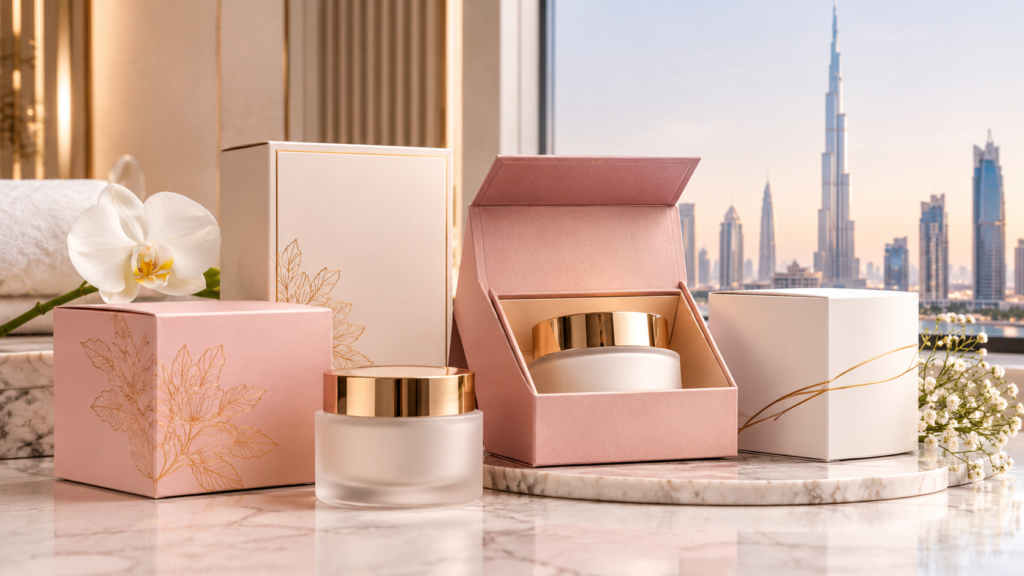
Choosing the right packaging is an important decision for skincare brands, cosmetic manufacturers, private-label businesses, distributors, and beauty retailers. Packaging must fit the product, protect it during handling, communicate the brand’s identity, and suit the business’s budget.
For companies sourcing cosmetic cardboard packaging in the UAE, the decision involves more than choosing an attractive box. Buyers need to compare board materials, carton styles, printing methods, finishes, minimum order quantities (MOQs), sampling, and delivery requirements.
Cream jar boxes need particular attention because jars vary in diameter, height, lid shape, and weight. A well-fitted carton can improve presentation and help reduce movement during handling, but it should be tested with the actual container before production.
This guide explains packaging options, cream jar boxes in the UAE, printing and finishing choices, MOQ considerations, supplier evaluation, and practical sourcing steps.
Cosmetic cardboard packaging refers to paper-based cartons and boxes used to present and protect skincare, beauty, and personal care products. Common applications include face creams, moisturizers, body butters, cleansers, serums, facial oils, and gift sets.
A skincare product can have two packaging components:
For example, a moisturizer may be sold in a glass jar placed inside a printed folding carton. The jar must be appropriate for the formulation, while the carton must fit the container and withstand normal handling. Businesses developing skincare and personal care products should plan the primary container and outer packaging together.
When assessing cosmetic packaging solutions, confirm whether the supplier offers primary containers, secondary cardboard cartons, or both. These are different product categories and should not be treated as interchangeable.
The right box depends on the product’s dimensions, weight, fragility, price positioning, and distribution method.
Folding cartons are printed, cut, creased, folded, and assembled. They are commonly used for retail skincare products because they support branded artwork and can be supplied flat before assembly. Potential uses include face cream boxes, cleanser cartons, serum packaging, and lightweight cosmetic products.
For many new brands, a folding carton with custom artwork can provide a professional retail appearance without the added construction of a rigid box.
Rigid boxes have a substantial construction and are often used for premium skincare sets, gift collections, and special launches. Decorative wraps, inserts, foil details, and other finishes can create a premium presentation. However, rigid packaging may increase unit cost, storage volume, and shipping requirements.
Corrugated board has a fluted layer between liner sheets. It is commonly considered for shipping and distribution rather than as the primary retail carton for an individual cream jar. Uses may include transporting several finished products, e-commerce shipping, and bulk distribution.
A retail carton and a shipping carton serve different purposes. A folding carton may present one product on a shelf, while a corrugated outer box may protect multiple units in transit.
Custom carton structures can accommodate unusual container dimensions or create a distinctive unboxing experience. Paperboard inserts may help position a jar and limit movement inside the box. Custom structures can require extra design, sampling, tooling, or setup, so compare their benefits against the added cost.
Board grade affects stiffness, folding performance, print appearance, and suitability for the intended use.
| Material | General characteristics | Potential application |
| Solid bleached board (SBB/SBS) | White, smooth surface suited to detailed printing | Premium skincare cartons |
| Folding boxboard (FBB) | Layered board commonly used for folding cartons | Cream boxes and retail packaging |
| White-lined chipboard (WLC) | Often uses recovered fibre with a coated outer surface | Selected cartons where the grade meets requirements |
| Corrugated board | Fluted construction designed for strength and cushioning | Shipping cartons and multipacks |
These materials are not interchangeable in every application. Actual performance depends on grade, thickness, structure, and manufacturer specifications.
Consider these factors before selecting a material:
The goal is to choose a material that meets functional requirements without paying for features the product does not need.
Cream jar boxes are used for moisturizers, face creams, night creams, body butters, masks, and other products packaged in jars. The most important design requirement is a correct fit. Measure the container’s external dimensions, including the lid or closure, rather than relying only on the product’s stated weight or capacity.
Two jars both sold as 50 g products may have different diameters, heights, lid shapes, and wall thicknesses. They may therefore require different carton sizes. For more context on primary-container selection, read the guide to glass jars and dropper bottles in the UAE.
| Box style | Potential use | Key consideration |
| Standard folding carton | Everyday retail skincare | Balance dimensions, material, and print quality |
| Premium carton with finish | Higher-end creams and gift products | Confirm finish, budget, and handling needs |
| Carton with insert | Jars needing extra positioning | Test the insert with the actual container |
| Rigid presentation box | Premium sets and special launches | Consider storage and shipping volume |
| Corrugated outer box | Bulk transport and shipping | Match structure to the load and route |
Prepare a clear packaging brief with:
Ask the supplier to recommend internal dimensions and a suitable structure. Avoid guessing the clearance yourself: excessive space can allow the jar to move, while insufficient space can make packing difficult or damage the carton.
A digital mock-up shows the artwork and general appearance but may not prove that the finished carton fits or performs correctly. Before bulk production, check that the jar can be inserted and removed easily, the lid does not catch on the flaps, the box closes properly, the jar does not move excessively, and the artwork sits in the intended position. For glass containers or long-distance distribution, assess the complete packaging system rather than assuming the retail carton alone provides adequate shipping protection.
If you are comparing container customization as well, review custom cosmetic packaging in Dubai. Confirm directly with the provider whether the exact cardboard carton, printing method, order quantity, and delivery arrangement you require are available.
Printing helps brands communicate identity and distinguish product variants. The right method depends on artwork, order quantity, board type, colour requirements, and supplier equipment.
| Printing method | General strengths | Questions to ask |
| Offset printing | Detailed graphics and consistent reproduction for suitable runs | What setup costs and quantities apply? |
| Digital printing | Flexible for shorter runs and artwork variations, depending on equipment | Which boards and finishes are supported? |
| Flexographic printing | Used across several packaging applications | Is it suitable for this board and level of detail? |
| Screen printing | Useful for selected specialized applications | Is it compatible with the substrate and order size? |
No method is automatically best for every order. Ask the supplier to recommend a process based on the actual design and provide a representative sample where possible.
Your print brief should include the approved logo, brand colours, typography, product name and variant, required product information, barcode or QR code if applicable, preferred finishes, artwork requirements, and approved dieline. A dieline shows the carton panels, folds, cutting lines, and glue areas. Keep important text away from these areas and proofread all copy before production.
Finishing options influence appearance, tactile quality, and cost. Choose treatments that support the brand rather than adding decoration without a clear purpose.
Before choosing several treatments, ask whether each one improves the packaging’s purpose. Clear branding, legible information, consistent colour, and a well-fitted carton may matter more than multiple expensive effects. A physical sample is the best way to assess the proposed board, print, and finish.
MOQ means minimum order quantity—the smallest quantity a supplier accepts for a particular product or specification. There is no single MOQ for all cosmetic cardboard packaging suppliers in the UAE. Minimums vary by supplier, carton structure, material, printing process, finishing, and customization.
Factors that can affect MOQ include:
| Business type | Practical approach |
| Startup or new skincare brand | Ask about standard structures, shorter print runs, and pilot quantities |
| Established manufacturer | Compare unit prices across realistic order volumes |
| Brand with several variants | Clarify whether each design has a separate MOQ |
| Premium launch | Compare custom construction and finishes against simpler options |
| Distributor or wholesaler | Balance volume pricing against storage, demand, and product changes |
A low MOQ does not always mean the lowest total cost. Smaller orders may have a higher unit price, while larger orders can tie up working capital or leave a business with obsolete artwork. Request quotes for two or three feasible quantities and compare unit price, total cost, setup, sampling, delivery, and other charges.
Cosmetic cardboard box costs depend on the full specification, not just the box size. Main factors include board grade and thickness, dimensions, structure, print coverage, finishing treatments, tooling, sampling, order quantity, packing, and delivery.
When requesting quotes from cosmetic packaging suppliers in the UAE, ask each supplier to specify:
Lead times vary with artwork preparation, sample approval, material availability, production scheduling, finishing, and transport. Confirm when the timeline starts: at purchase-order placement, artwork approval, or physical sample sign-off. Allow time for revisions and testing, and obtain the agreed schedule in writing.
Price is important, but the lowest quote may not be the best choice if the carton does not fit the jar, print quality is inconsistent, or delivery misses the launch date.
Evaluate suppliers using these questions:
A practical sourcing process is to prepare the product specification, request comparable quotes, review samples, test the carton with the jar, approve the artwork, confirm commercial terms, and inspect the delivered order against the approved sample.
Private-label skincare brands need packaging that looks consistent across the range and can be reproduced reliably as the business grows. A brand selling creams, moisturizers, serums, and lotions may need different carton sizes while maintaining consistent colours, typography, logo placement, and finishing.
A new brand may start with a standard carton structure and custom artwork before investing in more elaborate packaging. An established brand may prioritize custom dimensions, inserts, premium finishes, or coordinated cartons across several products. In either case, plan for future changes: product names, ingredients, claims, or regulatory information may require updated artwork.
For additional context, explore private-label cosmetics and read Ashwani LLC’s skincare formulation guide when coordinating packaging with product development.
Ashwani LLC’s website describes private-label cosmetics and packaging-related services, including containers such as tubes, bottles, glass jars, and PET jars, along with labelling and private-label support. Learn more about Ashwani LLC to review the business and its published services.
These services may be relevant when planning primary packaging and private-label requirements. However, businesses looking specifically for printed cardboard outer cartons, custom folding boxes, or cream jar boxes should confirm directly whether the required box styles, printing methods, quantities, and delivery arrangements are available. A general reference to packaging or labelling does not establish that every cardboard-carton service is offered.
When making an enquiry, provide the product type and jar dimensions, preferred carton structure and finish, artwork, initial and repeat-order quantities, target delivery date, and any documentation requirements. You can contact Ashwani LLC to ask about availability and confirm the specification before placing an order.
Selecting cosmetic cardboard packaging in the UAE requires a balance of fit, protection, branding, cost, MOQ, and delivery. For cream jar boxes, begin with accurate container measurements and test a physical sample before approving bulk production. Compare suppliers using equivalent specifications and verify material, print, and sustainability claims with documentation.
For B2B skincare and private-label brands, a clear packaging brief makes it easier to compare options and avoid costly production mistakes. Confirm that each supplier can provide the exact carton structure and printing service required before committing to an order.
Cosmetic cardboard packaging consists of paper-based cartons and boxes used to present and protect skincare, beauty, and personal care products. It can be customized by board grade, dimensions, printing method, structure, and surface finish.
Businesses can approach carton manufacturers, packaging converters, printing companies, and B2B packaging distributors. Compare material options, print quality, customization, MOQs, samples, and delivery terms before selecting a supplier.
Options include standard folding cartons, premium cartons with decorative finishes, cartons with inserts, rigid presentation boxes, and corrugated outer packaging. The right option depends on the jar’s dimensions, weight, fragility, brand positioning, and distribution requirements.
There is no universal MOQ. It depends on the supplier, board material, box structure, printing process, finishing requirements, and degree of customization. Ask for pricing at several feasible quantities before making a decision.
Offset printing may suit detailed graphics and larger production runs, while digital printing can offer flexibility for shorter runs. Flexographic and screen printing may suit particular packaging applications. Request samples and compare total costs for your specific design.
Yes, depending on the supplier’s capabilities. Customization may include logos, brand colours, printed product information, foil stamping, embossing, and selected finishes. Approve the final artwork and a representative sample before production.
Measure the jar’s widest diameter and overall height, including the lid. Provide these measurements to the supplier and explain whether an insert is required. Test a sample using the actual container before approving a bulk order.
Material grade, box dimensions, printing coverage, decorative finishes, tooling, order quantity, sampling, packing, and delivery can all affect the cost. An itemized quotation helps businesses compare equivalent specifications.
Their environmental impact depends on the material source, production process, coatings, adhesives, transport, and end-of-life options. Check supplier documentation before making claims about recycled content, responsible sourcing, or recyclability.
Prepare your jar dimensions, box style, preferred material, artwork, finish requirements, expected order quantity, delivery destination, and target timeline. Also identify any product labelling or documentation requirements relevant to your market.
