

Our Global export market
We provide our services all over the world. Where we can serve you ?
Contact Us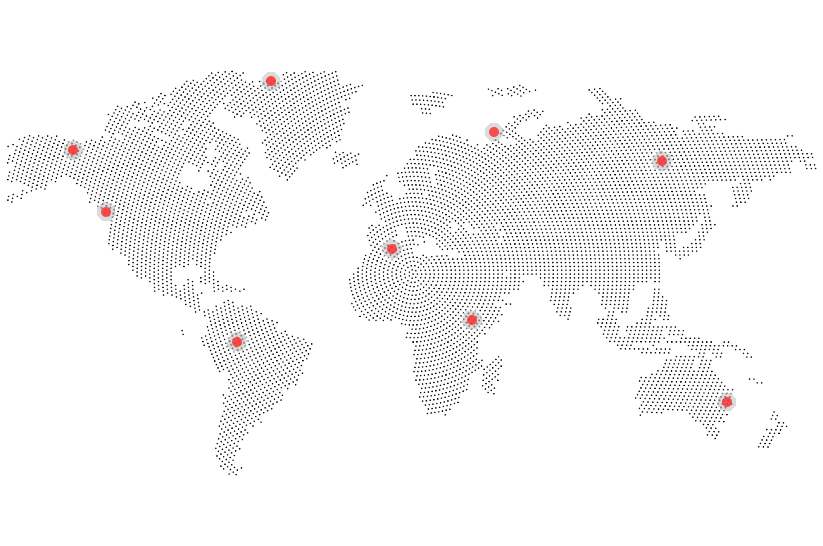
15 June 2026
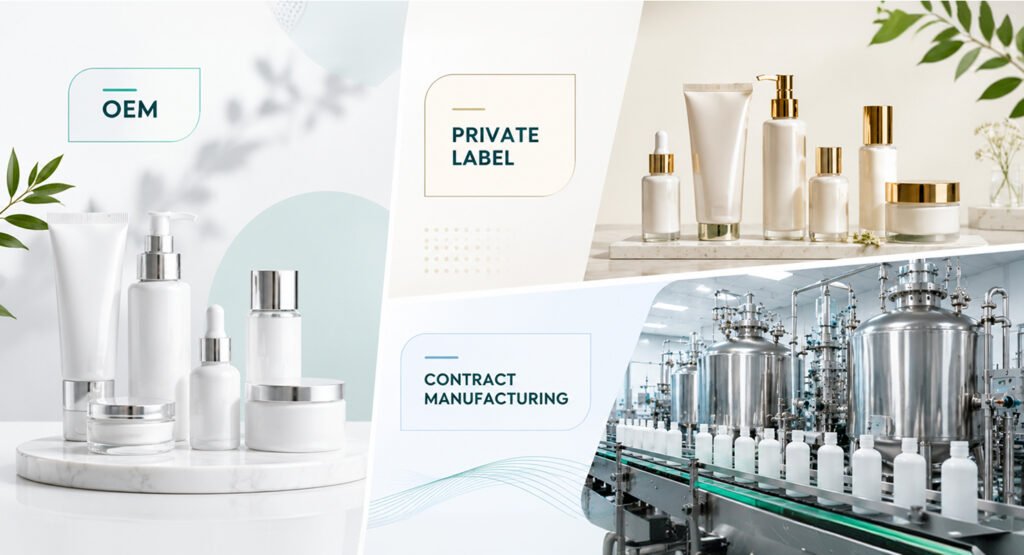
If you are building a cosmetics brand in the UAE and trying to figure out which manufacturing model to use, here’s the short answer: private labelling suits fast-moving startups, OEM suits brands that want a product that’s slightly their own without full R&D investment, and contract manufacturing suits founders who already have their own formula and just need production capacity. The right choice depends on your budget, timeline, formula ownership goals, and where you are in your brand journey.
That said, most founders I’ve spoken with in Dubai and across the GCC pick the wrong model in year one and pay for it later, either through a lack of formula ownership, MOQ mismatches, or regulatory headaches they didn’t see coming. The UAE cosmetics industry is projected to reach USD 1.2 billion by 2028, growing at a CAGR of around 5.8% (Statista, 2024). That’s a significant opportunity, but only if your production model is set up correctly from the start. Let’s break this down properly.
These three terms get used interchangeably in the market, but they’re genuinely different things. Confusing them leads to the wrong supplier conversations and the wrong contracts.
OEM (Original Equipment Manufacturer) in cosmetics is a model where the manufacturer designs and produces a product to your specifications, but the finished product is sold under your brand name. The manufacturer owns the base formula; you may request certain modifications. In short, OEM is a co-development model where you influence the product but the manufacturer holds the IP.
Private labelling in Dubai (and across the UAE) is the simplest and fastest model. A manufacturer already has a ready-made product, such as a vitamin C serum or a body butter. You pick it off their catalogue, add your brand name and packaging, and launch. No formula development needed. It’s the lowest-barrier entry point into the cosmetics market.
Contract manufacturing is the most involved model from the brand’s perspective. You bring the formula. The manufacturer is purely a production facility. They scale your recipe, source raw materials, ensure compliance, and hand over finished goods. You own the IP entirely.
Here’s a quick reference table:
| Feature | OEM | Private Label | Contract Manufacturing |
|---|---|---|---|
| Formula ownership | Manufacturer (with your modifications) | Manufacturer | You (the brand) |
| Speed to market | Medium (4-8 weeks) | Fast (2-4 weeks) | Slower (8-16+ weeks) |
| Customisation level | Medium | Low to medium | Very high |
| Upfront investment | Medium | Low | High |
| Typical MOQ (UAE) | 500-2,000 units | 100-500 units | 1,000-5,000 units |
| Best for | Growing brands seeking differentiation | Startups, quick launches | Established brands with unique formulas |
| IP risk | Medium | Low | None (you own it) |
The UAE is not just another market. It’s a re-export hub, a luxury beauty destination, and one of the highest per-capita beauty spenders globally. According to Euromonitor International (2024), UAE consumers spend an average of USD 300 per person annually on beauty and personal care, which is among the highest in the Arab world.
That commercial reality changes what production model makes sense. A brand launching here faces specific pressures that don’t apply in, say, Eastern Europe:
In my experience working with brands entering the Gulf market, the most common mistake is choosing a model based on global advice written for the US or European context. The MOQs, lead times, and regulatory steps in the UAE are different, and they should shape your decision.
Private labelling in Dubai is popular because it solves the most common problem a new brand founder faces: getting a quality product to market without spending six figures on R&D.
Here’s what you actually get with private labelling that most people don’t spell out:
The downside is also real. Any competitor can go to the same manufacturer and launch a near-identical product. Your differentiation lives entirely in your brand story, marketing, and customer experience, not in the formula. That’s fine for some businesses and fatal for others.
As cosmetics industry consultant Dr. Ritu Mehta noted in a 2023 industry roundtable, “Private label has become the preferred launchpad for MENA beauty entrepreneurs precisely because it separates the product challenge from the brand challenge. You focus your energy on what the customer sees and feels, not on what’s inside the jar.”
If you’re at the early stage of building your line, our private labelling services in Dubai are designed exactly for this scenario.
OEM is the middle ground, and it’s genuinely underused by startups in the UAE who leap straight from private label to contract manufacturing without realising there’s an option in between.
With OEM, you approach a manufacturer with a brief: a target skin type, a key active ingredient you want, a texture preference, and a price point. The manufacturer’s R&D team then builds a formula to meet your brief. You test, approve, and launch. The formula lives with the manufacturer; you get a product that feels more yours than an off-the-shelf private label option.
The critical detail is: OEM manufacturers in the UAE and Dubai typically require a minimum order of 500-2,000 units, and development timelines run 4-12 weeks depending on the complexity of the formulation. According to the Dubai Chamber of Commerce’s 2023 Beauty Industry Report, over 60% of UAE-based SME beauty brands use some form of OEM arrangement at their growth stage, making it the most common model for brands in the AED 500K-5M annual revenue bracket.
OEM makes sense when:
The limitation is IP ownership. If you later move manufacturers, you typically cannot take the formula with you unless your contract explicitly addresses this. Always clarify formula ownership terms in writing before signing an OEM agreement.
Contract manufacturing in Dubai is the right choice when your competitive advantage is the formula itself.
This is true for brands that have invested in dermatologist-developed formulas, patented ingredient combinations, or proprietary blends built on sourced raw materials that aren’t available on an OEM catalogue. Contract manufacturing is also common for brands that have grown beyond private label and now want to protect their bestselling formulas from competitor access.
The UAE has seen strong growth in local contract manufacturing capacity. A 2024 report by Grand View Research noted the Middle East and Africa cosmetics contract manufacturing market was valued at approximately USD 320 million in 2023, with UAE-based facilities accounting for an estimated 22% of regional capacity due to the country’s logistics infrastructure, free zone incentives, and regulatory alignment with EU Cosmetics Directive standards.
Here’s what contract manufacturing in Dubai involves in practice:
The whole process, from submitting your formula to receiving your first production batch, typically takes 12-20 weeks for a new product category. That’s a meaningful timeline commitment that rules out contract manufacturing as a first-launch strategy for most UAE startups.
For brands ready for this level, our team at Ashwani LLC supports the full journey from custom formulation through to production. You can also review our cosmetic manufacturing services in Dubai to understand the full scope of what UAE-based production can look like.
This is the question most comparison guides skip, so let’s answer it directly.
If you’re pre-revenue or in your first year: Private labelling in Dubai is almost certainly the right call. Your job right now is to test the market, build customer relationships, and generate cash flow. The formula is the least important variable at this point. Speed and unit economics matter most.
If you’ve validated a product and are approaching AED 1M in annual revenue: OEM starts to make sense. You now have feedback from real customers about what they want improved. You have the volume to justify a development fee. You want a formula that gives you a genuine story to tell retailers and press.
If you have a proprietary formula or have scaled beyond AED 5M: Contract manufacturing is the model that protects your asset, gives you full IP control, and allows you to negotiate manufacturing costs based on your volume, not the manufacturer’s catalogue pricing.
A few practical considerations for UAE founders specifically:
Our guide on private label cosmetic manufacturers walks through what to look for when vetting a manufacturing partner in the UAE.
Cost is what most founders ask about first, but it’s also the variable that’s most misleading without context. Here’s a realistic breakdown for the UAE market:
Private label in Dubai:
OEM in UAE:
Contract manufacturing in Dubai:
The hidden cost most founders miss is regulatory compliance. Whether you’re using private label, OEM, or contract manufacturing, every product sold in the UAE needs a valid DM cosmetic notification. Some manufacturers include this in their service; many do not. Budget AED 2,000-5,000 per product for this process if it’s not included.
For more on sourcing quality raw materials that feed into these processes, see our bulk carrier oils supplier guide and essential oils wholesale sourcing guide for Dubai brands.
The model you choose is only as good as the manufacturer behind it. Here’s a quick checklist for evaluating any cosmetics manufacturer in the UAE, regardless of model:
You should also ask for reference clients. Any established manufacturer in Dubai should be able to point you to at least two or three brands they’ve worked with. If they hesitate, that’s a red flag.
A note on sourcing support: one area where strong Dubai manufacturers stand out is in ingredient access. A manufacturer with established supplier relationships for premium raw materials, including GC-MS tested essential oils, carrier oils, and halal-certified actives, can significantly reduce your raw material costs and lead times, regardless of which manufacturing model you choose.
The OEM vs. private label vs. contract manufacturing decision is not a ranking question. There’s no universally “best” model. Private labelling in Dubai wins when speed and cash efficiency matter most. OEM wins when you need a product story and some level of customisation without full R&D investment. Contract manufacturing wins when you’ve built a formula worth protecting and have the volume to make it viable.
What I’d suggest is this: don’t start with the model. Start with your brand’s most pressing constraint right now. Is it time? Choose private label. Is it differentiation? Choose OEM. Is it IP control and scale? Choose contract manufacturing.
The UAE cosmetics market is growing fast, with the region’s beauty industry expanding at over 5% annually through 2028. That growth creates space for brands at every stage, but only if the production infrastructure behind them is set up to support growth rather than limit it.
At Ashwani LLC, we’ve spent over 25 years working across all three models, helping brands from Dubai, across the GCC, and globally source, formulate, and launch cosmetic products. Whether you’re looking for ready-made private label formulas, custom OEM development, or a manufacturing partner for your own formula, we can support the full journey.
Explore our private labelling services, review our cosmetics manufacturing capabilities, or contact us directly to discuss your project with our team. If you’re not sure where to start, simply tell us your product idea, your budget, and your target market, and we’ll tell you honestly which model makes the most sense for your situation.
OEM is where a manufacturer develops a product to your brief and you sell it under your brand; the manufacturer holds the base formula. Private label means you pick an existing ready-made product from a manufacturer’s catalogue and brand it as your own. Contract manufacturing is where you supply your own formula and the manufacturer produces it at scale. The key differences come down to IP ownership, customisation level, and time to market.
Yes, private labelling in Dubai is one of the best starting points for a new beauty brand. It requires the lowest upfront investment, offers the fastest launch timeline (often 2-4 weeks), and lets you test the market before committing to custom formulation. Most private label manufacturers in Dubai work with MOQs as low as 100-300 units, making it accessible even on a limited budget.
In private label, the manufacturer owns the formula. In OEM, the manufacturer owns the base formula, though you may negotiate modifications. In contract manufacturing, you own the formula entirely, since you supply it to the manufacturer. If formula ownership matters to your long-term brand strategy, only contract manufacturing gives you full IP control.
Private label is the fastest, typically 2-4 weeks from order to finished goods. OEM takes 4-12 weeks depending on formulation complexity and approval rounds. Contract manufacturing takes the longest at 12-20 weeks, accounting for formula validation, pilot batch testing, stability data, and regulatory submission. Always factor in Dubai Municipality cosmetic notification time (2-4 additional weeks) for any model.
MOQs vary by model and manufacturer. For private label, expect 100-500 units per SKU. For OEM, typical MOQs in Dubai run 500-2,000 units. Contract manufacturing generally starts at 1,000-5,000 units. These figures reflect standard UAE market conditions as of 2025-2026. Some manufacturers negotiate lower MOQs for multi-SKU brand launches.
Yes. Every cosmetic product sold in the UAE must be registered with Dubai Municipality (DM), regardless of the manufacturing model. Some manufacturers include DM notification support in their service package; others treat it as a separate service. Confirm this in writing before signing any manufacturing agreement. Unregistered cosmetics can be seized at the border and attract penalties.
Private label is the least expensive to start, with per-unit costs typically ranging from AED 10-40 including stock packaging. OEM adds a development fee (AED 3,000-15,000) and slightly higher per-unit costs due to custom formulation. Contract manufacturing has the highest upfront investment but can reach the lowest per-unit cost at scale. For a brand launching 3-5 SKUs, private label is nearly always the most capital-efficient entry point.
Both OEM and contract manufacturing can produce halal-certified cosmetics in Dubai, provided you work with a manufacturer that holds or can obtain halal certification for the specific product category. OEM is faster if you need a halal-certified formula quickly, as the manufacturer’s existing certified formulas can be adapted. Contract manufacturing is better if you have a proprietary formula you specifically want halal-certified.
Yes, and many successful UAE brands follow this exact path. They launch on private label to validate the market, then invest in custom formulas as they grow, transitioning to OEM or contract manufacturing at the 12-24 month mark. The main consideration when switching is that you’ll lose continuity of the private label formula (since you don’t own it), so you’re effectively relaunching with a new product. Some brands run both models in parallel.
For GCC exports, the model matters less than the manufacturer’s compliance capabilities. Whichever model you choose, your manufacturer should be familiar with Gulf Standardisation Organisation (GSO) requirements, Saudi SFDA notification processes, and halal certification standards. For brands targeting Saudi Arabia specifically, working with a manufacturer that has existing GSO registration experience will save significant time. Private label with a compliant Dubai manufacturer remains the fastest way to get export-ready products.
